Szymczak, Jean (D)

Szymczak, Jean

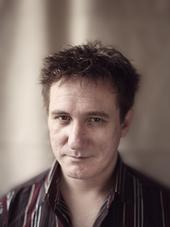
Jean Szymczak (born 1970 in Berlin) is a recording engineer. He produces features for radio stations, records orchstras, bands and film music. He contributed to the productions of the rado plays “Der Wind in den Weiden”, “Alice im Wunderland” and “Das Weihnachtsgeheimnis” by Jostein Gardner. Jean Szymchak has his own recording studio (Studio P4) at the legendary former radio house Nalepastraße with his partner as sound engineer and producer.

http://www.studiop4.de

appearance at Tuned City
radio space / 05.07.08

Dyrssen, Catharina (SE)

dyrssen

Catharina Dyrssen is Architect SAR/MSA and musicologist, associate professor/senior lecturer at the Department of Architecture, Chalmers University of Technology, Göteborg.

She teaches architectural and urban design, architectural theory and design research methodology, and is in charge of doctoral studies at the department. Earlier employments include architectural design practice and teaching contemporary music at the Academy of Music and Drama, and the Department of Musicology, Göteborg University.

In teaching and research Catharina Dyrssen is especially interested in questions relating architecture to music, sound, rhythm, and the urban sonic environment. She approaches sound as an integrated aspect of architecture when forming urban space and buildings. This involves critical investigations on how concepts of noise and sound are constructed as part of contemporary culture, social patterns and aesthetics. In turn, it leads to reconsidering conceptions of architectural space – questions of scale, spatial borders, centre and periphery, communication, materiality, spatial transgression and occupation, contradictions and correspondences between aural and visual perception etc. She also combines aspects of sound with questions on space and movement, including spatial sequences, bodily movement, and the consequences for urban design of mobility as a dominating, generative force in the contemporary urban landscape.

Within Urban Sound Institute (USIT), Catharina Dyrssen works with architectural and urban issues such as housing and traffic, interfaces between roadscapes and buildings, sound and public space, sound/space theory, spatial conceptualisation etc. She leads design workshops and seminars, and is active as lecturer and in public debates. She is a member of the steering committee of AKAD and coordinator for the USIT research project Transmission.

http://www.urbansound.org/

appearance at Tuned City
design of acoustic environments / 04.07.08

05.07.2008: radio space

Tuned City day 5 / block 1 / 11 am / radio house Nalepastraße

lecture
Gerhard Steinke
the room is the robe of the music: the acoustics of the radio house Nalepastraße

performance
Thomas Ankersmit / Antoine Chesex
diffusion – acoustics

guided tour
Gerhard Steinke / Gisela Herzog
the acoustics of the radio house

demonstration
Jean Szymczak
electro-acoustic demonstrations

presentation
Edwin van der Heide
Field of Overtones

nix

The former Funkhaus Nalepastraße, a historically protected building complex that was built 1951-56 in Berlin-Oberschöneweide and until 1990 was domicile fort he GDR radio, still impresses with its mixture of modernity and classicism, of monumentality and ironic casualty. The arched studio building contains several studios for recording and the production of radio plays as well as the famous hall 1, which Daniel Barenboim called “one of the best recording halls in the world”.

Gerhard Steinke, who supervised for 40 years the studios at Nalepastraße with the research laboratories for acoustics and audio technology and who can be considered as a pioneer of east German audio technology, will introduce this day and describe the special acoustic of the Funkhaus. After this, Steinke and the acoustical engineer Gisela Herzog will lead through the different production studios and architectural characteristics of the building.

Musicians Thomas Ankersmit and Antoine Chessex will perform a series of site-specific acoustic saxophone duets which aim to explore the particular sonic phenomenon intrinsic to each location.
Sound engineer Jean Szymczak will give insight into the work of a recording studio and demonstrate room acoustic design potentials on an architectural and electro-acoustic level. Additionally, the results of the field recording workshop with Chris Watson and presented as well as a new work by Edwin van der Heide, wich explores the natural behaviour of wind as a model of a space sound-movement. Both presentations give the opportunity to experience the excellent acoustic qualities of the studio spaces in a multi-channel set up.

04.07.2008: das kleine field recordings festival

Tuned City day 4 / block 3 / 9 pm / Wriezener Freiraumlabor

performance
das kleine field recordings festival

DKFRF is an ongoing, no-budget event dedicated to field recording and related sound art and electronic music organized by Rinus van Alebeek in some of the most unlikely venues around the city of Berlin. Now in its third year, it is coming close to being the most uninstitutional institution in town!

with:
Lasse Marc Riek will liberate the hidden sounds of the city with his ultrasonic microphones. His quest is for places where sounds are unheard.

Richard Francis (aka Eso Steel) has been active as an experimental music composer and improviser since 1996. His work over the years has explored different techniques of sound generation and processing, with a focus on the collection and digital processing of various natural and artificially produced sounds from the surrounding environment.

Harold Schellinx will witness and record the ongoings and report on it once everything is said and done. Schellinx’s performance will take place once everybody has gone home and has returned to their every day duties and pleasures. On the day of the dkfrf itself he will be present with a microphone and his observation skills. His reports will be published in his Soundblog (written and images) and as a sound report on the internetradio raudio.

Soinu Mapa is an open collaborative project. Based on “phonography” or the art of recording environmental sounds, their aim is to show, share and exchange field recordings made in the Basque Country.

The Phonographic Arkestra
(Wolfgang Dorninger, Richard Eigner, Stefan Messner, Joachim Knoll, Stefan Kushima, Michael Petri, Iduna Sickinger, Johannes Staudinger)

Quiring, Björn (D)

Quiring, Björn

Dr. Björn Quiring studied comparative literature and philosophy in Berlin, Paris and New York. He wrote his Ph. D. on the aporias of ritual cursing in Shakespeare’s histories and teaches literature at Viadrina University in Frankfurt/Oder. He is interested in literature as the persistent border conflict between the domain of textual signs and the areas that seem to remain beyond the grip of language, e. g. mere sound or the materiality of tangible objects. Quiring has published an article on the theologico-juridical uses of sound in Shakespeare’s „King Lear“ („Mark the high noises“ – „King Lear“ und der natürliche Grund des Donners, in: Shakespeare Jahrbuch 143, 2008, Bochum: Kamp) and diverse texts on noise and experimental music.

http://www.kuwi.euv-frankfurt-o.de/de/lehrstuhl/lw/westeuropa/mitarbeiter/bjoern_quiring/index.html

appearance at Tuned City
talking sound and building space / 05.07.08

Rambow, Riklef (D)

rambow

Dr. Riklef Rambow is an architectural psychologist and theoretician. Since 2001 he has been doing research and teaching at the Brandenburg Technical University (BTU) at Cottbus/Germany. Besides his involvement in the professional education of architects and urban planners he has substantially contributed to the successful establishment of a the new graduate study program on “Architectural Communication”, which is on offer at the BTU Cottbus since 2005.
His scientific work centers around the perception and use of architecture and public space, strategies for the communication of architecture to a wider public, and the investigation of participative planning processes. He has published several books as well as numerous articles and book chapters on these subjects. He has organized conferences and workshops and is a regular contributor to national and international conferences. Riklef Rambow also runs the consultant office for architectural psychology PSY:PLAN in Berlin.

http://www.tu-cottbus.de/Theo/Lehrstuhl/deu/Rambow.html
http://www.psyplan.de/

appearance at Tuned City
talking sound and building space / 05.07.08

Farmers Manual (A)

farmers manual bucky media

Farmers Manual is an electronic music and visual art group, founded in Vienna in the beginning of the nineties. The core members of the collective are Mathias Gmachl, Stefan Possert, Oswald Berthold, Gert Brantner and Nik Gaffney. Part of the very lively viennese electronic music scene of the 90s, Farmers Manual were succefully crossing the boundaries between electronic music, live visuals, experimental graphic and web design.

Their CDs, published through avant-garde labels such as Mego, Tray or OR, often contained multimedia content. Their most s ignificant release might be RLA (which stands for “Recent Live Archive”), a DVD released on Mego in 2003, which contains the bands extensive backcatalogue of live concert recordings from 1995-2003, compressed in mp3 format – totalling 3 days and 20 hours of audio content and released under a Copyleft licence.

As visual artists, Farmers Manual have been included in numerous international festivals, such as FCMM (Montreal, 1999), Avanto (Helsi, , nki, 2001), Art+Communication (Riga, 2006)

http://web.fm/

appearance at Tuned City
sound and social communication / 03.07.08

Behrendt, Frauke (D/UK)

behrendt

Frauke Behrendt conducts research into the experience of urban space via mobile media; focusing on interactive art, music and sound projects that experiment with this experience. She is currently finalising her PhD (DAAD funded) at the Department of Media and Film Studies at the University of Sussex, (UK), is on the steering committee of the International Mobile Music Workshop and is the German delegate for the European Action on Sonic Interaction Design (SID). Her book “Handymusik. Klangkunst und ‘mobile devices'” (“Mobile Phone Music. Sound Art and Mobile Devices”) has been published in 2004. Frauke’s research is published in English and German, and has been presented at various international conferences such as NIME and ISEA. She is a member of the “Centre for Material Digital Culture” and of Richard Sennett’s “NYLON Culture and Society” Seminar. Her blog about sound, mobile media, art and culture is at http://mobilesound.wordpress.com/.

appearance at Tuned City
public and private soundscapes / 03.07.08

04.07.2008: design of acoustic environments

Tuned City day 4 / block 2 / 2 pm / Wriezener Freiraum Labor

moderation
Prof. Golo Föllmer (Martin-Luther-Universität Halle)

project presentation
tx – büro für temporäre architektur
wriezener freiraumlabor

lecture
Catharina Dyrssen (Urban Sound Institute Stockholm)
into noise: approaching the urban through transdisciplinary sound design projects

presentation
Gilles Aubry
the chant of the buidings – composing with field recordings

lecture
Gregoire Chelkoff (Cresson Grenoble)
listening in motion : an architectural experimentation for a public shelter

presentation
Barbara Willecke / Brigitte Schulte-Fortkamp
the redesign of the Nauener Platz

presentation
raumlaborberlin
Eichbaumoper

performance
Martin Howse
Active City Circuit

lecture / field walk
Chris Watson
listenining to the city

performance / workshop presentation
Staalplaat Soundsystem / Lola landscape architects /
in collaboration with Sound Studies UdK Berlin / TU Berlin
Composed City

nix

Acoustic design for environments explores the topic of sound and city on the scale of an urban wasteland.

On the premises of the former Wriezener Bahnhof in Berlin-Friedrichshain, a public park will be developed in the next years. tx architects develops ideas in close relation to the citizen in order to plan and realise this park together with neighbours, pupils, initiatives and locals shops. The challenge is to create a public free space that is open to a variety of functions and supports the living qualities in this city quarter.

How can urban acoustic phenomena be exploited for urban planning? Which possibilities exist to use the notion of aesthetical sustainability as an urban planning argument? Which part do acoustic criteria play in this context? The architect Catharina Dyrssen from the Urban Sound Institute Stockholm and the architect Grégoire Chelkoff from the Cresson Institute Grenoble present examples of projects that investigate the function of sound in the design processes of (free) spaces and give insight into the work of their institutes. raumlabor_berlin presents their vision of the transformation of the underground station Eichbaum in the periphery between Mu?hlheim ad Essen into an opera house. Urban planner Barbara Willecke presents the redesign project Nauener Platz in Berlin that focuses particularly on the exploration and testing of means to positively influence of noise and sound situations.

The performance Active City Circuit by Martin Howse investigates electromagnetic space. Complicated technical methods of filtering and amplifying of these signal waves are also subject of a workshop. Chris Watson and Gilles Aubry will present their work with fieldrecordings, their recording strategies, compositional concepts and discuss topics like forms of hearing, abstraction vs. representation and their fascination of the beauty of “found” sounds.

Staalplaat Soundsystem and Lola landscape architects, together with students of Sound Studies (UdKBerlin) and the TU Berlin, will present the results of the workshop Composed City which tries to use the area of the Wriezener Bahnhof as sound source and instrument.

atelier le balto (D/F)

lebalto

atelier le balto are Laurent Dugua (*1967) architect; Marc Pouzol (*1966), landscape architect; Véronique Faucheur (*1963), urban planner, and Marc Vatinel (*1967), landscape architect. The group was founded in 2001 and has its offices in Berlin and Paris.

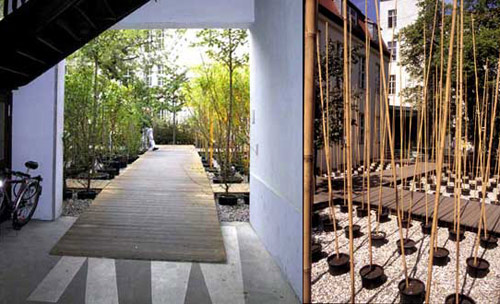
atelier le balto’s landscape architecture ist mostly a minimal intervention, derived from the substance and characteristics of the place – of its special quality. Their temporary gardens create an aesthetics that forms by the on-site found materials and plants.

“woistdergarten? / whereisthegarden?”, one of the Berlin projects of the office, is an ongoing series of temporary gardens that each use gaps between buildings, waste land or remaining places on different locations in the Berlin city for a year or a summer.

http://www.lebalto.de/

appearance at Tuned City
installation Punktierter Garten

von den Driesch, Roswitha (D)

Roswitha von den Driesch was born 1964 in Salzburg. She studied architecture in Mainz, was trained as a graphic designer and studied art / sculpture at the Kunsthochschule Berlin-Weißensee with a masters degree under Inge Mahn. She also attended the seminars at the electro-acoustic studio at the TU Berlin under Robin Minard. Since 1994 she has collaborated with Jens-Uwe Dyffort. They received various awards and grants, a. o. the Deutscher Klangkunstpreis 2006.

http://www.dyffort-driesch.de/

appearance at Tuned City
installation Punktierter Garten

Dyffort, Jens-Uwe (D)

Jens-Uwe Dyffort was born 1967 in Erfurt, he lives and works in Berlin. He studied composition at the University of the Arts Berlin under Franz Martin Olbrisch and Walter Zimmermann. 1998 he completed his masters degree under Walter Zimmermann. 1999 he took part in the Académie d’Eté at IRCAM Paris. Since 1994 he has collaborated with Roswitha van den Driesch and is software developer for NATIVE INSTRUMENTS.

http://www.dyffort-driesch.de/

appearance at Tuned City
installation Punktierter Garten

Strobl, Hannes (A)

strobel

Hannes Strobl (A) is a bass player and composer who lives and works in Innsbruck and Berlin. The starting point for his musical language is the abstract potential of the electric bass and upright bass. In the last few years, his main instrumental and compositional focuses are on musical forms of expressions in connection with our urban soundscape. He has produced many works for radio, dance, theatre, film and sound installations.

http://www.hannesstrobl.de

appearance at Tuned City
sound – space – architecture / 02.07.08

Feldmann, Joachim (D)

Dr.-Ing. Joachim Feldmann has worked as research assistant in the departments of technical acoustics at the Technical University Berlin since 1977. After training as a radio and TV
technician and studies in computer science and electrical engineering in Hamburg and Berlin, he specialised in the realm of noise reduction, acoustic measurement technology and room and architectural acoustics. Latter is topic of some lectures on the Department of Architecture at the TU Berlin. Currently he is interested in problems of low-frequency noise immisions in residential buildings as well as hearing and seeing in room acoustics.

appearance at Tuned City
listening to soundspaces / 02.07.08

03.07.2008: public and private soundscapes

Tuned City day 3 / block 3 / 4 pm / Alexanderplatz

moderation
Susanna Niedermayr

lecture
Frauke Behrendt (University of Sussex)
navigating hybrid spaces via sound

presentation
Udo Noll
radio aporee ::: maps

lecture
Dr. Michael Bull (University of Sussex)
sound moves: media technologies and urban spaces

lecture
Jens Gerrit Papenburg (Humboldt Universität Berlin)
Muzak. Zum Hören des Nicht-Hörens

lecture
Dr. Jürgen Altmann (Universität Dortmund)
acoustic weapons

presentation
Cláudia Martinho (mesarchitecture)
counter tactics

nix

Which role does sound play as a tool for design, as a social filter, as a communication catalyst or as warning system? How public is Alexanderplatz from the acoustic perspective?

Cultural scientist Frauke Behrendt conducts research into the experience and reflection of urban space via mobile media; focusing on interactive art, music and sound projects that experiment with mobile technology. In her talk she questions the possibility of sound to navigate in urban space. The artist Udo Noll presents an open sound-mapping project that is filled with sounds using mobile phone as a microphone.

Michael Bull, media scientist and iPod-expert, talks about the influence of mobile sound and communication technology on our experience of the urban environment, the creation of own mobile auditory worlds and the resulting changes of social behaviour.

Jens Gerrit Papenburg investigates in his research subliminal phenomena and will introduce functions and effectiveness of Muzak. The physicist Jürgen Altmann discusses a different, hardly less-subtle form of violence: acoustic weapons. The architect Cláudia Martinho describes in return experiments and tactics of urban practice that counteract a monopolization and control of public space with acoustic means.

03.07.2008: sound and social communication

Tuned City day 3 / block 2 / 1 pm / Alexanderplatz

short presentations, sound walks, performances on and around Alexanderplatz – a. o. with:

performance:
agf
Alexa

performance:
Farmers Manual
BuckyMedia

walk:
Sam Auinger
sound walk

lecture:
Frans Voogelar
beyond you-topia

presentation:
Rob Curgenven and Katie Hepworth
TACIT:TACET: milan sound atlas

presentation:

Peter Sinclair, Alejandro Duque and Julien Clauss
the locus sonus lab

nix

A number of performances, sound walks and short presentations will explore and illustrate the impact and function of sound in the architectural scale of urban space.

In this context, the social space of a shopping mall – already defined by a diversity of sounds – provieds an interesting challenge. How consciously or unconsciously does one perceive an acoustic climate? How does Muzak work? Is it possible to experience such a complex building as a sounding body? The Berlin based musician agf will examine these questions by performing a concert via the Muzak system of the Alexa shopping mall.

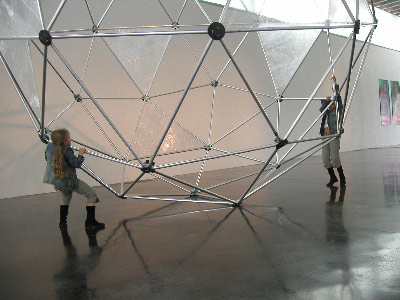
Inspired by the geodetic architecture of Buckminster Fuller, Farmers Manual developed their project BuckyMedia – huge, 5 meter wide wireframe balls: multi-sensory, sounding, geodetic spheres that are both sound object and control system. The movements of the balls in physical space generates and modifies data, sounds and images in imaginary data space and transmits it back to the real world.

The sound artist Sam Auinger explores the Alexanderplatz with a sound walk , unassisted by any technical gear. Katie Hepworth and Rob Curgenven introduce their research project TACIT:TACET: Milan Sound Atlas, which analyzes temporary-spatial aspects of a geo-politicised city. Frans Vogelaar gives insight in the collaboration projects of architects, urban planners, communication designers and media artists in theframework of his studio Hybrid Space Lab, in search of new forms of dealing with space, a. o.

03.07.2008: urban space & sonic experience

Tuned City day 3 / block 1 / 11 am / Alexanderplatz

moderation
Christa Kamleithner (Universität der Künste Berlin)

lecture
Prof. Susanne Hauser (Universität der Künste Berlin)
the eye, the ear and the big city

lecture
Pascal Amphoux (Cresson Grenoble)
sonic effects and other criteria of public space

lecture
Raviv Ganchrow (Institute of Sonology Den Haag/department of Architecture TU Delft)
phased space

nix

Alexanderplatz as a place of visionary iconography: from the early projects of the avantgarde, Döblin’s Alexanderplatz and the major project of the GDR-modernity up to the present “visionary” stone wallpaper. In terms of the number of visitors, Alexanderplatz can be called as one of the most dense – and maybe the most public – places of the city, an overlapping of traffic space and shopping space in the city centre.

The art historian and cultural scientist Susanne Hauser investigates this special aesthetic of agglomeration/urban compression in her work and searches for alternative models of description for the urban space. How is the urban space around the Alexanderplatz acoustically defined and coined by its usage and overlap of different functionalities?

These and similar questions are approached by architect and geographer Pascal Amphoux from the renowned research institute Cresson in Grenoble. The architect and sound artist Raviv Ganchrow will question what happens to the notion of ‘space’ and ‘place’ when examined through a sonic lens. Which vocabulary and which concepts exist to talk about sound in public space? For the planned conference situation, raumlabor_berlin will use a part of the outside staircase of the TV-tower as an open-air theatre and an oversize “city mattress” which invites the participants to sit and relax.

02.07.2008: sound – space – architecture / ohrenstrand: singuhr – salon

Tuned City Tag 2 / block 3 / 8 pm / ohrenstrand auf dem Pfefferberg: singuhr salon 2/08 / Pfefferberg Haus 13

moderation
Prof. Holger Schulze (Sound Studies, Universität der Künste, Berlin)

panel
Bernhard Leitner, Sam Auinger, magma architecture

performance
tamtam
Hometown

nix

The ohrenstrand salons of singuhr – hoergalerie on the Pfefferberg center on questions of installative sound art. On three evenings in the year, artists, mediators and scientists engage in discussions with the audience about experiences and questions of presentation, about architectural dimensions and the development and the history and design of acoustic environments, and last but not least about artistic approaches and working methods of the genre. The programme of the salon closely follows the exhibition activities of the sound gallery. This evening presents Sam Auinger, an artist who currently prepares together with students of the UdK Berlin an exhibition at Großer Wasserspeicher, that will open on 24 July. Also on the panel are Bernhard Leitner and the architecture office magma architcture, the discussion is moderated by Holger Schulze of the masters programme Sound Studies.

“Hometown” by tamtam follows this. This performance of Sam Auinger, Hannes Strobl, Michael Moser and David Moss focuses on the locations where our personal urban life takes place and what is special about them. The basis material consists of recordings of urban situations/spaces in Innsbruck, Linz and Berlin. Hometown is devided into four movements and a prologue, which explore the communicative quality of specific spaces and merge all the collected material into a composition.

02.07.2008: building with sound

Tuned City day 2 / block 2 / 3 pm / Brunnenstraße 9

lecture
Rahma Khazam
Sounds like Architecture

short presentations / project demonstrations
magma architeture / Sam Auinger (consultant)/ Gehörgänge
Mark Bain / Arno Brandlhuber (b&k+ Arno Brandlhuber, Berlin) / BUG

performance
Mark Bain

afterwards tour:

installation / Staalplaat Store / Le Petit Mignon
Brandon LaBelle / Room Tone, 18 sounds in 6 models

installation / Aedes Trafohaus / Pfefferberg
magma architeture / Sam Auinger (Beratung)/ Gehörgänge

installation / Großer Wasserspeicher (a project by singuhr – hoergalerie)
Aernoudt Jacobs / Echolocation

installation / Wasserturm Quartier (a project by singuhr – hoergalerie)
Akio Suzuki / oto-date NA GI SA

installation / Kleiner Wasserspeicher (a project by singuhr – hoergalerie)
Ulrich Eller / Talking Drums

nix

The construction site Brunnenstraße 9 of the architect b&k+ Arno Brandlhuber gives the opportunity to look at practical perspectives and concrete architectural approaches and projects that work with sound as material and plan a design idea from an explicit acoustic perspective.

Rahma Khazam examines several recent architectural projects in which sound plays a prominent role: these range from projects in which architects apply acoustic or musical notions to the design of buildings, to collaborations between architects and sound artists, some of which seek to blur the distinction between the two disciplines.

Tuned City has attempted to encourage several new collaborations in this context, and will introduce two very different projects and their processes here: BUG, a work by Mark Bain and Arno Brandlhuber that is planned as a permanent installation, will be demonstrated on the construction site, and the collaboration between sound artist Sam Auinger and magma architecture who will work on a prototype of acoustic design.

After this is the chance to visit several partner exhibitions: At the Staalplaat Store, Brandon LaBelle opens his project Room Tone. In and around the water reservoirs in Prenzlauer Berg Carsten Seiffarth of the sound gallery singuhr – hoergalerie will give an introduction to the works Echolocation by Aernoudt Jacobs, oto-date NA GI SA by Akio Suzuki and Talking Drums by Ulrich Eller.