Infrasound

infrasound

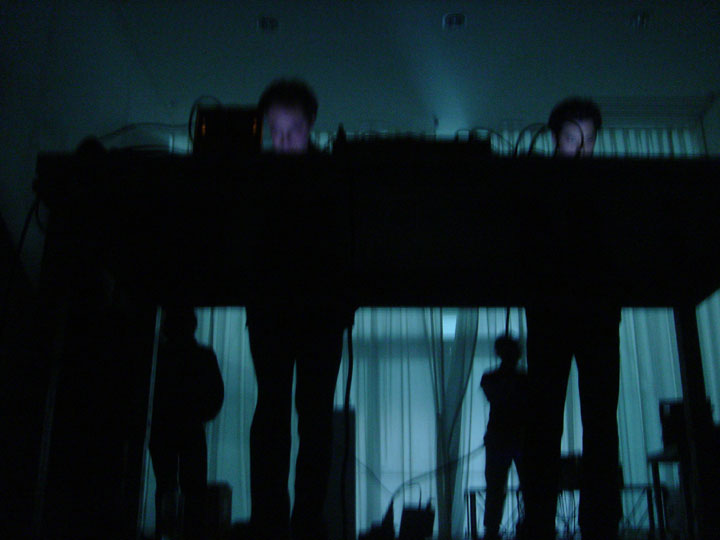
performance by Randy Yau / Scott Arford

Hear with your body. This is not about music. This is not about performance or the performer. The goal is sound and the explicit translation of sound into physical force. The goal is internal and external realization. It is about provoking new modes of perceiving and experiencing one’s own body – triggering variable and autonomous psycho-physiological response. It is about the total acoustic sense of space – observing sound to measure the capacity of architecture. It is about the phenomenon of resonance or sympathetic vibration – all things working in one continuum.

Infrasound is a spacial-acoustic concert series, initiated and performed by Randy Yau and Scott Arford with changing guests. The series investigates the possibility of sound, especially low frequencies, to measure the capacity of architecture; it is about the physicality of sound and the physical experience of sound. Each space has its individual resonance, specific frequencies are amplified, others muted. Each space is filled with as much frequency as needed until the space starts playing itself. Things in the space start to vibrate or to rattle. The audience feels the frequencies on their own bodies. Each concert is bound to the architecture of the venue. As an acoustic container, the space becomes a laboratory for experiments.

http://www.23five.org/infrasound/

Niedermayr, Susanna (A)

Susanna Niedermayr, born in Vienna in 1972, studied painting and political science. From 1995 to 2000 she was a member of WochenKlausur, a Vienna-based international group of artists, who make sociopolitical interventions at the invitation of art institutions and cultural organisations since 1993. She has been working as a journalist, presenter and Web designer at the ORF (Ö1, FM4) since 1996 (amongst also as a presenter for the ORF Kunstradio). In 2002, she set up line_in:line_out. Since 2008 she has been co-producer of the ORF Ö1 programme Zeit-Ton for which she has worked as an editor since 2000. She has published in various magazines, and has worked as an organiser, consultant and curator, a. o. for Wien Modern, Wiener Festwochen and Turning Sounds (Warsaw). Since 2007, she has been curator of musikprotokoll at steirischer herbst. Co-author (together with Christian Scheib) of In The East . New Music Territories in Europe., PFAU, 2002 (dt./eng.) and European Meridians. New Music Territories., PFAU, 2003 (dt./eng.). She is living and working in Vienna.

appearance at Tuned City
public and private soundscapes / 03.07.08

Hauser, Susanne (D)

hauser

Susanne Hauser is a professor for art history and cultural studies at the Faculty of Architecture of the University of the Arts Berlin.

1983–88: researcher at the Technical University of Berlin, working on semiotics. 1989: PhD thesis about literary views of the city; 1988–95: Employed at the Büro für Organisationsberatung in Berlin. 1995–96: Fellow at the Wissenschaftskolleg zu Berlin (Institute for Advanced Study). 1999: Habilitation thesis in cultural studies on the transformation of old industrial sites. Teaches cultural studies and architecture in Berlin, Innsbruck, Kassel and Stockholm; guest lecturer in Washington D.C. and Paris.

Recent publications: Metamorphosen des Abfalls: Konzepte für alte Industrieareale (Frankfurt am Main and New York, 2001); Spielsituationen: Über das Entwerfen von Städten und Häusern (Cologne, 2003); Ästhetik der Agglomeration, Wuppertal (with Christa Kamleithner, 2006).

appearance at Tuned City
urban space and sonic experience / 03.07.08

BUG

bain sensor

installation by Mark Bain in cooperation with b&k, Arno Brandlhuber
Brunnenstraße 9 / 22.01. 10 Eröffnung (permanente Installtion )

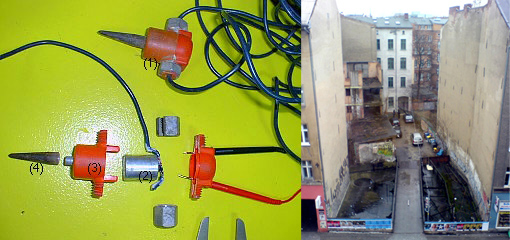
The project Brunnenstraße is a complete new planning for two invest ruins of Berlin’s 90ies.
Brandlhuber’s construction is using the already built basement and places a 5-floor, very light and transparent concrete building in-between two old typical Berlin fire division walls. This building is going to house a gallery and Brandlhuber’s own studio.

Mark Bain was involved in the construction process from the beginning on in order to develop a work which turns the whole building in a sound installation. He implemented a system of geodata and seismic sensors in the infrastructure of the building as well as in the concrete as the building was raised. These hyper-sensitive instruments caputere all mechanic and acoustic micro sensations happening in and around the building, like the wind passing by the fassade, foot steps on the stairs, raindrops on the roof, termic material expansion, etc. – all this raw material generates a permanent composition, played back via a public headphone jack in the fassade of building – so that all people passing by can plug in their own headphones and tune in and listen to the building.

Punktierter Garten – Punktiertes Fragment

punktierter garten

Installation by Jens-Uwe Dyffort and Roswitha von den Driesch
Tafelgarten at Hamburger Bahnhof by atelier le balto / 01.07. – 20.07. 08

When the Hamburger Bahnhof was built and rebuilt into the museum for contemporary art, the plan of the architect Josef Paul Kleihues – to erect a second big gallery on the left side of the building – was not realised. Today, this part of the building ensemble seems in the architectural context like an oddment, a fragment. The different construction plans from different times, the structures of the former train station, the architecture of the present museum and the passage to the new exhibition halls can be seen here.

The atelier for architecture, atelier le balto, designed a garden on this location, „woistdergarten? – Der Tafel-Garten“, that by use of different materials like wood, water, plants, clinker, sand and rails take up these architectural structures.

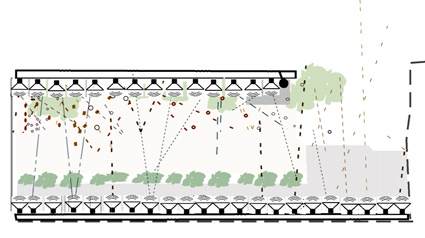
With their sound installation Punkierter Garten – Punktiertes Fragment Jens-Uwe Dyffort and Roswitha von den Driesch take up the spatial structures of the space in relation to the garden and enhance them into a temporal, acoustic sound space. Hundreds of small piezo speakers are installed on the opposed walls of the former station. The speakers are triggered by electric impulses to click. They animate the environment to echo and thus amplify the sensation fort the surrounding space. The speakers represent a self-triggering and developing system that slowly rising takes up the architectural directions. The accumulating fine noise of clicks mixes with the noise of the city, with the steps of passing visitors, until the reach an acoustic denseness that then abruptly stops. The only noise left are cars, people on the parking slot, listeners in the garden, birds and the humming of the city in the distance.

Room Tone, 18 sounds in 6 models

roomtone

installation by Brandon LaBelle
Staalplaat Store / Le Petit Mignon
/ 02.07. – 20.07. 08

Working with six architects from around the world, Brandon LaBelle sent them a series of recordings of his apartment in Berlin. Trying to sound the space, the recordings document the ambient, material and dimensional conditions of the apartment. The architects were then given the task of making a physical model of the apartment by having the sounds as their only directing information. In this way, a process of translation and interpretation unfolds, incorporating an understanding, however factual or fantastical, of the auditory into the process of rendering a spatial form – what we might call “noise design”.These models are presented at the Staalplaat record shop, and are further complemented by a series of audio recordings made by different people of their homes in the city. These home recordings form a soundtrack to the models, teasing out the relation between the audible and temporal experiences of home life and the coordinates of an architectural imagination.

Participating architects:
Carlos Campos
Lise Laurberg
Oren Lieberman + Tanja Mergler
Yeoryia Manolopoulou
Cláudia Martinho
Jonathan Mosley + Sophie Warren

oto-date NA GI SA

Akio Suzuki

installation by Akio Suzuki
Wasserturm Quartier / 25.05. – 14.09. 08

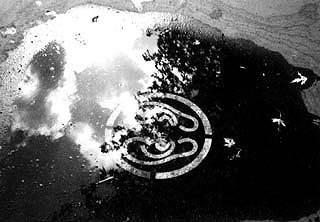
In the public space around the water tower square, Japanese artist Akio Suzuki presents a sound installation that is focused on listening to everyday situations. oto-date NA GI SA are not installed loudspeakers in a public space but special pictographically marked audial points located around the neighbourhood – places with extraordinary acoustic and atmospheric features that invite the visitor to listen. By stepping on the nine white markings, the visitor experiences the artists’ selected audial positions. This installation, a singuhr-sound gallery contribution to the Berlin “ohrenstrand.net” instrumental New Music project, which continues through 14 September, will be opened with a performance by Junko Wanda on Saturday, 24.05. at 6 p.m. as part of the “HouseMusik” festival.

oto-date NA GI SA is a project of singuhr – hoergalerie.

Suzuki, Akio (JP)

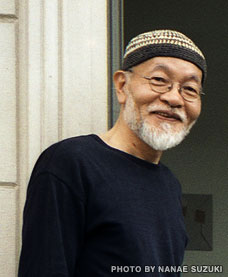
Akio Suzuki is known as a pioneer of sound art, but the breadth of his activities and the form of his works far exceeds the normal boundaries of sound art. It is perhaps more as a “quester after sound and space” that he has received the most attention from artists in many fields. Suzuki’s journey as an artist began in 1963 with a performance at Nagoya station, in which he threw a bucket full of junk down a staircase. The inspiration behind this performance – the idea that if one were to hurl an object down a well-balanced stairway, a pleasant rhythm might be the result – took the desire to “listen” as its subject. That desire to hear, to listen has remained the one constant in Suzuki’s stance as an artist. […]

http://www.akiosuzuki.com/

appearance at Tuned City
Brussels / oto-date guided / 29. June 2013
Brussels / ma-ta-ta-bi / 30. June 2013
Berlin / building with sound / 03.07.08
Berlin / oto-date NA GI SA

Echolocation

echolocation

installation by Aernoudt Jacobs
Großer Wasserspeicher / 24.05. – 13.07. 08

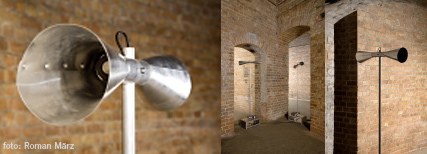
Echolocation is centred around the complex acoustic relationships in the inner part of the Large Water Reservoir’s concentric ring architecture. Subwoofers give the architecture variable tonal colourations in the individual rings that are counterpointed by rotating high range notes. Accompanied only by selected light sources, the visitors use special detectors that recapture the functional principles of an echo-sounder that help them navigate through the darkened labyrinth. Acoustic signals that are reflected from the surrounding architecture shed light on the individual location and consolidate into a constantly changing sound space.

Echolocation is a project of singuhr – hoergalerie.

Composed City

composedcitymap

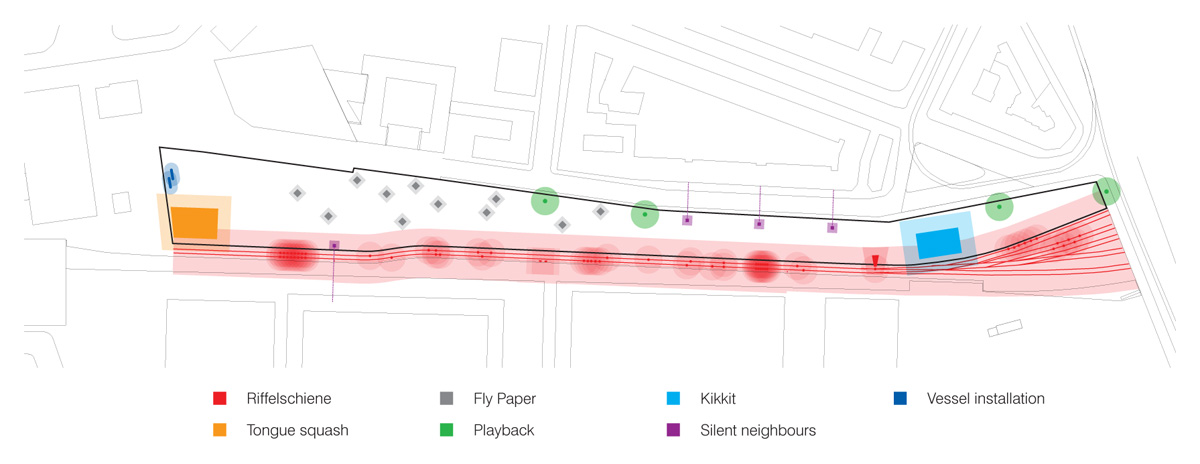
From 4 July till 8 July 2008, a workshop was organized for architecture students of the TU Berlin and sound studies students the UdK Berlin on the topic of sound (art) in public space. The unique mixed group developed ideas on how sound design and physical design of public space can be combined, and how public space can be played (function) as an instrument. These ideas were projected on a specific location, the Wriezener Freiraum in Berlin-Friedrichshain.
The location; a “to be-Park” that used to be a part of the Wriezener train station, could be seen as a typical non-place: a space that is defined by its borders, physically and aurally. The location was tested and mapped for its acoustic character and potential (sonotopes) from a sound as well as urban and landscape perspective. The sports potential that was present, linked to playful social acoustic interaction emerged ore even dictated by the location itself, so that spatial en sonic morphing of local elements and interaction created unexpected result.

The sound works give attention to the different activities in the park, inviting people to play, and make the activities audible. Like manipulating the rails with small kerfs and welds and acoustically amplifying its sound, the acoustic potential of the train and the rail network is being explored. The kinetic energy of people is used in an interactive way to set up the basis for new sonotopes.
A series of giant wooden tongue drum boxes is hung on the empty walls, The tongue drums invite the sportsmen to play them; they add a tonal layer to the composition and become a part of the game. Or a special type of stone grills is developed for this place. When the coals burn, hot air is lead through a revolver-construction of low whistles; this allow the griller to choose the tone. Brightly coloured cone-shaped plastic buckets cover the outer sides of the 6-meter high fence of the sports court During a game of basketball or football, the cones will amplify the sound of the impact of a ball against the steel fence. The frequency and intensity will vary according to where the ball hits the fence and how hard one kicks it. These new sonotopes are a blend of foreground and background sounds, like sound objects filed with Berlin flies – Musca domestica In some works the relation between these two is explored: the physical borders of the Wriezener Freiraum are opened aurally. Not only distance but also the natural rhythms make the sonotopes dynamic, and changing each two hours, each day, each week, each shower.

The presentation of the workshop results will take place at Tuned City on the 4th and 5th July 2008.

Composed City is organised by Staalplaat Soundsystem and Lola landscape architects in collaboration with Sound Studies (Universität der Künste Berlin), Technische Universität Berlin and tx – büro für temporäre architektur.

for more information and registration see

http://www.composedcity.org

Föllmer, Golo (D)

föllmer

Prof. Dr. Golo Föllmer is media scientist and musicologist. Born 1964 in Karlsruhe. Trained as a piano builder. Studies in Music and Communication (Technical University, Berlin) as well as Broadcast Communication Arts (San Francisco State University). Radio, audiotape works, sound installations. Publications on sound art and contemporary music. Cooperated for the festivals and exhibitions “sonambiente” (Akademie der Künste, Berlin 1996) and net_condition (ZKM Karlsruhe 1999). 2002 Ph.D. on Net music. Since 1998 lecturer at the University of Halle-Wittenberg at the Institute for Musicology, since 2002 at the Institute for Media and Communication. Since 2007 Junior Professor for “intercultural media science: focus audio culture”. Research: aesthetics and reception of media based art form (electracoustic music, sound art, radio art, netmusic), function and aesthetics of music and sound design in audiovisual media (film, video clip, computer game), history of the audio media in intercultural comparison, systematics of the audiocultural research.

http://www.medienkomm.uni-halle.de/kontakt/mitarbeiter/foellmer/

appearance at Tuned City:
design of acoustic environments / 04.07.08

Kamleithner, Christa (A/D)

kamleithner

Christa Kamleithner studied architecture and philosophy in Vienna. From 2000-04, she was author and editor for dérive – Zeitschrift für Stadtforschung (journal for urbanism) and from 2001-2006 board member of the Autrian Society for Architecture. In 2003, she worked for the EU research project “Urban Catalyst”. From 2004-05 she was research project assistant at the TU Graz and worked for the Ladenburger Kolleg Zwischenstadt. Since 2006, she has been research assistant at the University of the Arts Berlin, Faculty of Art and Cultural History in the degree programme Architecture. Since 2007, Christa Kamleithner has been assistant lecturer at the Center for Metropolitan Studies at the TU Berlin. Recent publications: Ästhetik der Agglomeration (with Susanne Hauser), Wuppertal: Müller + Busmann 2006; Schwerpunkt dérive 31, 2008: Gouvernementalität. Her research investigates theory of the social space, architecture as a medium, history of urbanism and new planning methods.

appearance at Tuned City
urban space and sonic experience / 02.07.08

Jacobs, Aernoudt (BE)

jacobs

Aernoudt Jacobs, born in 1968, lives and works as a composer and sound artist in Brussels. Field recordings play a significant role in many of his installations – sounds that are separated from their original context and reworked to create new relationships and contexts. Perceptive phenomena and cognitive processing of sounds often take centre stage.

appearance at Tuned City
building with sound / 02.07.08
Echolocator / 08.07.11

Schellinx, Harold (NL)

Schellinx, Harold

Harold Schellinx (Maastricht, the Netherlands) is an artist, writer, improvisor and creator of unusual and original musics. As a member of The Young Lions and several other post-punk bands in the Amsterdam of the late 1970s and early 1980s, he was among the initiating forces of the dutch ‘Ultra’ movement (the purely dutch version of what has become known as ‘post-punk experimental pop music’). He was co-founder, editor and London correspondent of the dutch modern music magazine ‘Vinyl’, while pursuing (in Holland, Belgium and the UK) a range of widely acclaimed musical projects. These include ‘Commuters’ – a collaboration with German singer Dagmar Krause (Slapp Happy/Henry? Cow), ‘Signs & Symptoms’ – with Peter Mertens, and a series of ‘pop fictions’ (Bogdan Wlosik, Agonie Ajournée …) – written and produced together with Ronald Heiloo.

Schellinx studied formal music and computer assisted composition with Gotfried Michael Koenig at the Institute of Sonology (Utrecht University), and mathematics and its foundations at the University of Amsterdam (PhD 1994).

Since 2000 his musical work growingly has become based on his ‘sonic diary’, an audio cassette archive of monophonic recordings made of his (and others’) everyday activities, always with a lapel microphone and a dictaphone walkman. The ‘sonic diary’ covers a period of over 30 years

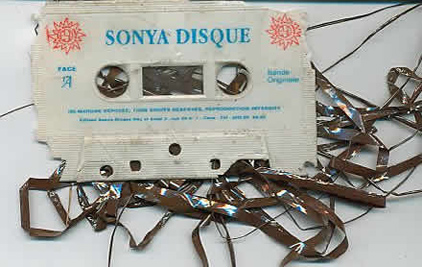
Schellinx’ current activities include : • the Amsterdam based eclectic media duo ‘ookoi’, who over the past four, five years have been assembling a collection of sound- and other media works conceived of as the continuous re-arrangement and transformation of extracts from ookoi’s growing library of live and field recordings; ookoi’s work, situated somewhere between performance-art and concert, between theater and music, between visual and sound art, has been published on CD, DVD, in the form of a DDD (Digital Data Dump), through audio web streams, as well as through a series of podcasts (audio) and vodcasts (audio/video). • the Paris based quarted ‘Diktat’, in whose performances electroacoustic improvisation with dictaphones and lo-fi field recordings is set to meet free improvisation on traditional acoustic instruments (double bass, saxophone); • the online ‘found tapes exhibition’, which meticulously records in ‘blog format’, the efforts and results of restauring the audio tape debris that he is picking up from the streets through which he passes since early 2002. He documents his and related work online since 2002 in the ‘soundblog’. He is editor-in-chief of Raudio, a collection of 24/7 audio webstreams hosted by the Amsterdam based artists collective PARK4DTV.

Schellinx is living and working in Paris (France) and Amsterdam (the Netherlands).

http://soundblog.net
http://raudio.nl

appearance at Tuned City
das kleine field recordings festival / 04.07.08

Francis, Richard (NZ)

francis

Richard Francis (aka Eso Steel) has been active as an experimental music composer and improviser since 1996. His work over the years has explored different techniques of sound generation and processing, with a focus on the collection and digital processing of various natural and artificially produced sounds from the surrounding environment.

He has released solo and collaborative sound works on labels such as Drone Records, Stateart, Celebrate Psi Phenomenon, Digitalis Industries, Absurd and Scarcelight, as well as his own label CMR. Currently CMR is focused on documenting the blossoming Auckland music scene on lathe cut record.

As a performing artist he has toured in Japan, Australia, Hong Kong, New Zealand, Canada and the USA. From 2003-2006 Francis operated ACROMA (along with Rosy Parlane), an organization that coordinated a series of experimental music events in Auckland hosting local and visiting experimental sound artists. Francis is a member of the Alt.Music committee, and in 2005 joined the board of the New Zealand Audio Foundation.

He has collaborated for recording and/or performance with Birchville Cat Motel, MSBR, Empirical, Tetuzi Akiyama, Gate, Mattin, Lawrence English, Rosy Parlane, Greg Headley, Pumice, Whitebass/Clinton? Watkins, Howard Stelzer, Kuwayama Kiyoharu, Phil Dadson, Joel Stern, Sean Kerr, Andrew Clifford, Anthony Guerra, Sean Meehan, Antony Milton, James Kirk, MHFS, Tim Coster, Paul Winstanley, Ishigami Kazuya, Takefumi Naoshima, Toshihiro Koike, Jason Lescalleet, Jay Sullivan, Jason Kahn.

http://www.cmr.co.nz/

appearance at Tuned City
das kleine field recordings festival / 04.07.08

The Phonographic Arkestra (A)

Members (in alphabetic order):

Wolfgang Dorninger
– works on the interface of electronic music, multimedia art and sound art. He runs the label base records. Various works based on field recordings. http://dorninger.servus.at, http://bikemike.blogr.com/

Richard Eigner – is composer, sound artist, producer and percussionist who moves on the interface of improvised electronics, jazz and minimal music. For the project “Denoised City” he cleaned urban field recordings of their acoustic dirt.
http://www.myspace.com/richardeigner, http://www.wald-entertainment.com

Stefan Messner – moves between E and U. As a melancholic loner in his solo live act “mes.” or as a rioting pack of animals in the alternative concept of the topos boyband called “s.kushima /a.tell/m.eisenmann/w.oei”. Also: film, video, projections …
http://www.backlab.at/mes, http://www.myspace.com/mesbacklab

Joachim Knoll – musician, producer, composer, DJ, radio show Host
http://www.comeonfeet.net

Stefan Kushima – on field recordings based psychdrones; releases on diverse underground labels.
http://www.backlab.at/kushima

Michael Petri

Iduna Sickinger – figur in the feld, student of audiovisual media and musician in the classic sense. Has worked with recording and modifying of arbitrary and deliberate sound only for a short time.

Johannes Staudinger – founder of the Merker TV and the label merker.tv records. DJ for GenderBender. Field recordings since 1998.
http://www.merker.tv/

appearance at Tuned City
das kleine field recordings festival / 05.07.08

Riek, Lasse-Marc (D)

riek

The work of Lasse-Marc Riek is an assemblage of the most diverse styles and techniques. His interdisciplinary productions are shaped by elements of the fine arts, phonography, environmentalism, performance, sound-art and conceptual art. These productions are situated in a tight relationship with one another. They complement and enrich one another — just like human beings, created by nature, find themselves in an ongoing process of change and are part of the eternal becoming and fading. In the domain of phonography Riek’s focus rests on acoustic ecology and bio-acoustics by means of field recordings of both society and nature. His music, recorded with a microphone, is brought about by coincidence and the immediate presence of nature, society and animals. In his quest after the archaic sound Riek collaborates with scientists, ecologists and musicians.

http://www.lasse-marc-riek.de

appearance at Tuned City
das kleine field recordings festival / 04.07.08

Soinu Mapa (ES, Basque Country)

Soinu Mapa is an open collaborative project. Based on “phonography” or the art of recording environmental sounds, our aim is to show, share and exchange field recordings made in the Basque Country.

Soinu Mapa started thanks to a collection of recordings made by Luz Maria Sanchez in 2001. During a residence at Arteleku, this mexican sound artist did dozens of field recordings on different geographical locations of the basque country, from south to north, east to west. This collection was archived on Arteleku mediateque, ready to be used by any artist, as Luz Maria wrote on the documentation. Three years later, Audiolab created Soinu Mapa, in order to present in public all this collection and create a even bigger archive based on the same philosophy.

Oier Iruretagoiena and Xabier Erkizia are both sound artists and radiomakers. They are politically as well as culturally active in the diffusion of field recordings in the Basque Countries. In this way they have helped to create an institutional recognition of this art form that can be considered quite exclusive in the European Community. At the dkfrf they will present Soinu Mapa, and use the sounds as a starting point for their performance.

http://www.soinumapa.net/

appearance at Tuned City
das kleine field recordings festival / 04.07.08

05.07.2008: talking sound and building space

Tuned City day 5 / block 3 / 5 pm / radio house Nalepastraße

lecture
Björn Quiring
The Foundational Sounds of Vitruvius

lecture
Elisabeth Sikiaridi (HybridSpace Lab / University Essen)
Morphologies or the Architectures of Iannis Xenakis

lecture
Olaf Schäfer and Urs Walter (Berlin)
design with sound

lecture
Riklef Rambow (TU Cottbus)
Rock’n’Roll ain’t Noise Pollution: Architectural Expertise and the Communication of Aural Architecture

panel
with all participants / moderation: Barry Blesser

nix

In the Funkhaus, which was planned as an ideal production place of virtual sound worlds, questions and approaches on an imaginary acoustic space for association and simulation will be presented.

The literary scholar and philosopher Björn Quiring describes the movement of human history as a co-evolution of language and architecture, and their importance as representatives of political power. Questions of complexity and (mathematical) translation models from sound into architecture and vice versa in the work of the Greek composer and architect Iannis Xenakis is investigated by the architect Elisabeth Sikiaridi. Olaf Schäfer and Urs Walter talk about possibilities of a language to describe the acoustic space and about a concrete planning project that generates an architectural language and space design from acoustic analysis.

The research in architectural communication of Riklef Rambow approaches the differences in perception of architecture between architects and amateurs and with overcoming these differences through communication. Here, the focus normally lies on the visual qualities of architecture. This field shows how much the expertise of architects is reflected in refined perception patterns, an elaborate conceptual thinking and corresponding terminology. What does this look like in the realm of the acoustic, however? Which differences in perception and description exist between architects and amateurs and which consequences for successful communication strategies result from this?

A final discussion panel under the moderation of Barry Blesser tries to draw a balance of the past days and to give an outlook on possible potentials of Tuned City.

05.07.2008: sonic derive

Tuned City day 5 / block 2 / 3 pm / radio house Nalepastraße

lecture
Jan-Peter Sonntag
Arbeiten im raum

performance
Jacob Kirkegaard
Labyrinthitis

nix

Jan Peter E.R. Sonntag is interested in the spatiality of sound as an amorphous body one can walk through in relation to possible space models as well as in spaces that only start to form in the head through psychoacoustic ambiguous phenomena and thus work diametrically opposed to our visual perception. On the basis of his early “raum-Arbeiten” with high frequency sinus tone interference fields and architectures of standing pressure waves on one hand, and the seemingly endless sonic air currents he has produced since 1993 on the other hand, he will present acoustic perceptual spaces that are constituted differently than their physical boundaries might indicate. He will also talk about his own body as an acoustic reception space, since we hear not only through the system of our ears but first and foremost in the brain.

Jacob Kirkegaard has turned his ears inwards for his new work Labyrinthitis, a three-part interactive sound piece that consists entirely of sounds generated in the artist’s auditory organs – and will cause audible responses in those of the audience. Labyrinthitis relies on a principle employed both in medical science and musical practice: When two frequencies at a certain ratio are played into the ear, vibrations of the hair cells in the cochlea will produce a third frequency. This tone is generated by the ear itself: a so-called “distortion product otoacoustic emission” (DPOAE), referred to in musicology as the “Tartini tone”.