Khazam, Rahma (F)

Rahma Khazam is a freelance writer and journalist based in Paris, France. She has published numerous articles on music, sound and art in magazines, journals and anthologies and given lectures on the role of sound in contemporary art. She is also the editor-in-chief of Earshot, a British journal addressing the relations between sound and architecture. Current activities include curating a sound programme at Palais de Tokyo in Paris, organizing an international symposium on sound, art and architecture scheduled for July 2008 and preparing a conference on the use of sound as a weapon.

appearance at Tuned City
building with sound / 02.07.08

Howse, Martin (UK/D)

howse

Martin Howse operates within the fields of discourse, speculative hardware (environmental data in open physical systems), code (an examination of layers of abstraction), free software and the situational (performances and interventions). Heavily improvised, playing with the collapse of massed, barely functional salvaged equipment and software systems made manifest in sound/noise and image, Howse presents a complex, process-driven constructivist performance; the symphonic rise of the attempt to piece together fugal systematics is played out against the noise of collapse and machine crash at the deserted border of control.

http://1010.co.uk/

appearance at Tuned City
Tuned City Messene 2018 – Listening Politics
Brussels / enclosed detection environment (EDE) / 30. June 2013
Berlin / design of acoustic environments / 04.07.08
Berlin / scrying

Ganchrow, Raviv (US/IL/NL)

Raviv Ganchrow’s (1972) work focuses on interrelations between sound and space, aspects of which are explored through sound installations, writing and the development of sound forming technologies such as Wave Field Synthesis. He addresses an ambiguous status of sound that is at once material-spatial as well as phenomena-event. Recent installations directly engage the everyday acoustic environment, plumbing notions of ’place’ that are constructed by way of frequency interdependencies between sound, location and listener. Ganchrow completed his architectural studies at the Cooper Union, New York and received a second degree from the Institute of Sonology at The Royal Conservatory, The Hague. He has been teaching architectural design in the graduate program at TU Delft, and is currently a faculty member at the Institute of Sonology, The Hague. He has been co-curated the Tuned City conferences in Tallinn and Brussels.

http://ravivganchrow.com

appearance at Tuned City
urban space and sonic experience / 03.07.07
Inwound / installations
Tuned City Tallinn / pre-events
Tuned City Nürnberg / 2011
Tuned City Messene 2018 – Listening Politics

Chessex, Antoine (CH/D)

chessex

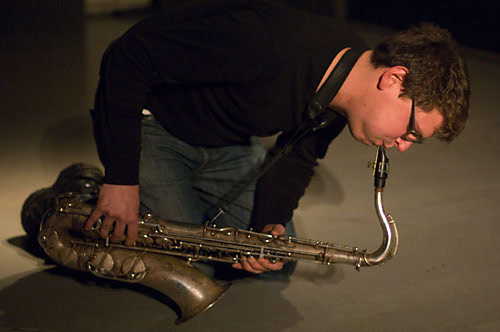
Antoine Chessex, born in 1980 in Switzerland, is a key spoke in the wheel of Europe’s experimental music community, and a hub in the electro-acoustic improvising scene. Based in Berlin, he performs internationally with various projects including the noise-metal outfit Monno. After saxophone studies in Lausanne, Sienna and New York, he moved to a more radical approach including different forms of sonic experiments. Parallel to his acoustic playing, he developed an unusual use of the saxophone while sending it through a Marshall guitar amplifier and using circular breathing techniques. Drones, vocal mayhem and chaotic electronic behaviour is mixed together in an extremely intense manner.

http://www.soundimplant.com/achessex.html

appearance at Tuned City
radio space / 05.07.08

01.07.2008: opening

Tuned City day 1 / 8 pm / Pfefferberg Haus 13

keynote
Dr. Barry Blesser
spaces speak, are you listening?

keynote

Anton Garcia-Abril (Ensamble Studio Madrid)
building for sound

installation
Nik Hummer
Sperrgut

performance
Randy Yau / Scott Arford
Infrasound

performance
BMB con.

nix

“We experience spaces not only by seeing but also by listening. We navigate a room in the dark, and ‘hear’ the emptiness of a house without furniture. Our experience of music in a concert hall depends on whether we sit in the front row or under the balcony. The unique acoustics of religious spaces acquire symbolic meaning. It is possible to learn to see with your ears, but even without training, we can all hear spatial geometry such as an open door or low ceiling.” Barry Blesser, who belongs to the pioneers of the digital audio revolution, will introduce the concepts and vocabulary of aural architecture with his lecture on acoustic spatial perception.
The Spanish musician and architect Antón García-Abril – son of the Spanish composer of the same name – designs and constructs buildings for music. His minimal concert hall architectures in Medina el Campo or Santiago del Compostela are planned for concerts of new and experimental music and vary the topic of the “white cube” as an ideal space with the most flexibility for the changes and the development of performance practice.
Both lectures approach the topic of architecture and sound from different perspectives, they question our perceptive habits and our way of dealing with space.

The Dutch performance group BMB con. will as usually not give away what they are planning to do, perhaps they don’t even know themselves. One thing is certain, they are going to change the performance space thoroughly. BMB con. work with sound, image, space and whatever they can lay their hands on. So far they have performed in every kind of space, in museums, concert halls, forests, ships or water tanks – but never in a zoo.

With their performance Infrasound, the Americans Randy Yau and Scott Arford explore the possibility to experience space both acoustically and physically. The play with the resonance of material, with acoustic phenomena, sound cancellation and sound shadows and create thereby an impressive physical sound experience.

Chelkoff, Grégoire (F)

Grégoire Chelkoff is architect and director of Cresson (Centre de recherché sur l’espace sonore et l’environnement urbain) at the University for Architecture in Grenoble (Ensag).

Research carried out at the laboratory focuses on the perceptible environment, and architectural and urban atmospheres. CRESSON advocates a qualitative approach liable to help and perhaps influence design strategies and processes. After concentrating initially on the sound space, the laboratory extended the scope of its inquiries in the 1990s to include the many dimensions of in situ sensory perception. The research addresses phenomena related to light, heat, smell, touch and bodily movement. Research draws on original pluridisciplinary methods, at the meeting point between human and social science, between architecture and engineering science.f

One of the results of this work is the publication “Sonic Experience. A Guide to Everyday Sounds”. The book investigates the effects of sounds on listeners. In a multidisciplinary work spanning musicology, electro-acoustic composition, architecture, urban studies, communication, phenomenology, social theory, physics, and psychology, the authors provide an alphabetical sourcebook of eighty sonic/auditory effects.Their accounts of sonic effects such as echo, anticipation, vibrato, and wha-wha integrate information about the “objective” physical spaces in which sounds occur with cultural contexts and individual auditory experience.

http://www.cresson.archi.fr/

appearance at Tuned City
design of acoustic environments / 04.07.08

Bull, Michael (UK)

bull

Dr. Michael Bull is a Reader in Media and Film at the University of Sussex and has written widely on sound, music and technology. He is the author of “Sounding Out the City. Personal Stereos and the Management of Everyday Life” (Berg 2000), “Sound Moves: iPod Culture and Urban Experience “(Routledge 2007) and is co-editor of “The Auditory Culture Reader” (Berg 2003). He is also the founding editor of The Senses and Society Journal published by Berg. He was until recently a consultant to Portalplayer, California and is a core member of New Trends Forum, a European think tank funded by Bankinter, Spain.

http://www.sussex.ac.uk/mediastudies/profile119032.html

appearance at Tuned City
public and private soundscapes / 03.07.08

Brandlhuber, Arno (D)

brandlhuber

1993- free-lance 1994-1996 project partnership Neanderthal Museum; Zamp Kelp and Julius Krauss, Arno Brandlhuber 1995-2001 office Brandlhuber, office b&k+ Brandlhuber&Kniess + Partner / b&k+b,m / b&k+r, Cologne 2001-2006 b&k+ brandlhuber&co, Cologne 2003- chair in architecture and urban planning, Academy of Fine Arts Nuremberg, www.a42.org 2006- b&k+ Arno Brandlhuber, Berlin

http://www.brandlhuber.com

appearance at Tuned City
building with sound / 02.07.08
and
BUG

Blesser, Barry (US)

blesser

Dr. Barry Blesser is considered one of the grandfathers of the digital audio revolution. He invented and developed the first commercial digital reverberation system, the EMT-250 in 1976, helped start Lexicon in 1971, published the landmark paper, “Digital Processing of Audio Signals” in 1978, co-chaired the 1st International Conference on Digital Audio in 1980, and was an adviser to the US Justice Department on the Watergate Tapes in 1974. Dr. Blesser was President of the Audio Engineering Society in 1980. The AES awarded him their Silver, Bronze, and Governors Medals, both Publication Awards, and made him an AES Fellow. He has been on the AES editorial review board since 1975, and currently serves as its Consulting Technical Editor. Dr. Blesser has published numerous papers in professional journals and has been awarded many patents on audio and signal process.

After receiving his S.B, S.M and Ph.D. from MIT in Electrical Engineering in 1964, 1965, and 1969, Dr. Blesser served on the MIT faculty from 1969 to 1978 as an Associate Professor of Electrical Engineering and Computer Science. He taught courses on electronic, instrumentation, and audio technology while conducting research in the Cognitive Information Processing Laboratory.

After leaving academia in 1978, he has been a technical and management consultant working with more than 50 companies worldwide. He often functions as a change agent using the principles of risk engineering to maximize productivity and profitability. In addition, he has been an expert witness on patents cases, a Director of Engineering, and Chief Technology Officer, and a founding officer of several startup companies.

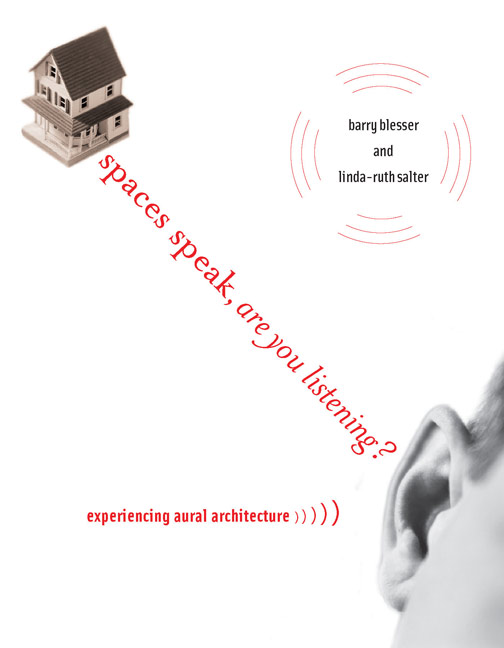
Most recently, MIT Press published his first book (together with Linda-Ruth Salter): “Spaces Speak, Are You Listening? Experiencing Aural Architecture”, which has provoked a latent interest in sound and acoustics worldwide. Dr. Blesser, as a passionate advocate of the social consequences of corrosive acoustics, offers lectures and assistance to those who want to be proactive in improving the aural quality of life.

http://www.blesser.net/

appearance at Tuned City
opening / 01.07.08
and
talking sound and building space / 05.07.08
Auinger, Sam (A/D)

sam auinger

Sam Auinger was born in Linz, Austria in 1956 and now lives and works in Berlin. Since the bgeginning of the 1980’s he has dealt intensively with the subjects of composition, computer music, psycho acoustics, and sound design.

Together with Bruce Odland, he founded O+A in 1989. Their central theme is a “hearing perspective”. Their projects include Garten der Zeitraume (Ars Electronica 1990, Linz), Traffic Mantra (at Trajan’s Forum in Rome, 1991), Sound Design for Peter Sellars’ The Persians (Premiere: Salsburger Festspiele 1993), Balance (Sonambiente Berlin 1996), Box 30/70 (beginning in 2000, Siemens, Berlin), Blue Moon (New Sounds New York, 2004).

He and Viennese composer and musician Rupert Huber have a longstanding musical friendship. As DAAD fellowship recipiants in 1997, they founded the media band berliner theorie.

Auinger frequently works with composer Hannes Strobl (tamtam), choreographer Marguerite Donion and composer Class Willeke. After several joint projects, Sam Auinger, Dietmar Offenhuber and Hannes Strobl formed the artistic group stadtmusik in 2005.

Over the years Sam Auinger has received numerous prizes and awards for his work. Most recently he became the youngest artist to receive the Kultur Preis der Stadt Linz (2002) to honor his body of work, the daad-stipendium (1997) and the SKE Publicity Preis 2007.

http://www.samauinger.de/

appearance at Tuned City
building with sound / 02.07.08
sound – space – architecture / ohrenstrand: singuhr – salon / 02.07.08
sound and social communication / 03.07.08
Auditory Corridors
Tuned City Nürnberg / 2011
bonn hoeren – »a hearing perspective« / 10.07.11

Arford, Scott (US)

arford

Scott Arford is one of the leading figures of new media arts in the San Francisco Bay Area. He has produced numerous works for sound and video including multichannel installations, live performances, CD and DVD projects. He was awarded an Honorable Mention in the 2005 Prix Ars Electronica. Arford has shown his in numerous venues including the San Francisco Museum of Modern Art; Dissonanze 7 in Rome, Italy; LUFF Festival in Lausanne, Switzerland; Observatori Festival in Valencia, Spain; the Sounding Festivals in Guangzhou, China and Taipei, Taiwan; the LEM festival in Barcelona, Spain; Liquid Architecture in Melbourne, Australia; the Festival de Video / Arte / Eolectronica in Lima, Peru; Sonic Light in Amsterdam; and the Center for Contemporary Arts in Kitakyushu, Japan.

Arford holds a Bachelor of Architecture from the College of Architecture and Design at Kansas State University.

In 1995 Arford founded 7hz, a warehouse/performance space dedicated to supporting live electronic experimental media. 7hz has since featured such international artists as Francisco Loppez, Zbigniew Karkowski, John Duncan, Bob Ostertag, John Bischoff, The Haters and more.

http://www.7hz.org/

appearance at Tuned City
opening / 01.07.08

Ankersmit, Thomas (NL/D)

ankersmit

Thomas Ankersmit (born 1979 in Leiden, The Netherlands) is a musician and installation artist based in Berlin. Initially an improvising saxophonist, his activities expanded to include live electronic music and installation pieces based on architectural acoustics and infrasound. He has been performing solo and in collaboration with other artists such as New York minimalist Phill Niblock, Kevin Drumm, Jim O’Rourke, Gert-Jan Prins, Borbetomagus and Alvin Lucier since 1998. Since 2003, Ankersmit most frequently collaborates with Niblock and Milan-based electroacoustic improviser Giuseppe Ielasi.
His saxophone work focuses on the abstract, timbral extremes of the instrument, combining sustained streams of intense multiphonic sound with acoustically amplified micro-events occurring inside the instrument.

[lang_ee] Thomas Ankersmit (s 1979 Leidenis, Hollandis) on Berliinis elav muusik ja installatsioonikunstnik.
Alustanud improviseeriva saksofonistina, on tema tegevussfäär laienenud, kaasates elektroonilist muusikat ja installatsiooniteoseid, mis tuginevad arhitektuurilisele akustikale ja infrahelidele. Alates 1998. aastast on ta esinenud nii solistina kui ka teinud koostööd teiste muusikutega, nagu näiteks New Yorgi minimalist Phil Niblocki, Kevin Drummi, Jim O’Rourkei, Gert-Jan Prinsi, Borbetomaguse ja Alvin Lucieriga. Alates 2003. aastast on Ankersmit kõige tihedamalt töötanud koos just Niblocki ja Milanos tegutseva elektro-akustilise improvisaatori Giuseppe Ielasiga. Ankersmiti saksofonitöö keskendub instrumendi abstraktsetele tämbrilistele äärmustele, mis kombineerivad intensiivseid mitmefoonilisi, pidevalt voolavaid helisid instrumendi sees ilmnevate, akustiliselt valjendatud mikromuutustega.
[/lang_ee]

appearance at Tuned City
listening to soundspaces / 02.07.08
radio space / 05.07.08
Speaking with Spaces / 09.07.11
sonic peculiarities of sites / 08.+10.07.11

[lang_ee]Tuned City programmis
varem:
listening to soundspaces / 02.07.08
radio space / 05.07.08
Tuned City Tallinn 2011:
Kõnelused ruumiga / 09.07.11
piirkondade helilised iseärasused / 08.+10.07.11[/lang_ee]

Amphoux, Pascal (F)

Pascal Amphoux, Architecte DPLG, Geograph Contrepoint Projets urbains, Lausanne (Suisse), a professor at the faculty of architecture Nantes, France (Ecole Nationale Supérieure d’Architecture de Nantes). Freelance architect and consultant for urban planning projects (Bureau CONTREPOINT, Projets urbains, Lausanne). Research at the Centre de Recherches sur l’Espace Sonore et l’Environnement Urbain (CRESSON, Ecole d’Architecture de Grenoble, UMR CNRS).

Research carried out at the laboratory focuses on the perceptible environment, and architectural and urban atmospheres. CRESSON advocates a qualitative approach liable to help and perhaps influence design strategies and processes. After concentrating initially on the sound space, the laboratory extended the scope of its inquiries in the 1990s to include the many dimensions of in situ sensory perception. The research addresses phenomena related to light, heat, smell, touch and bodily movement. Research draws on original pluridisciplinary methods, at the meeting point between human and social science, between architecture and engineering science.

One of the results of this work is the publication “Sonic Experience. A Guide to Everyday Sounds”. The book investigates the effects of sounds on listeners. In a multidisciplinary work spanning musicology, electro-acoustic composition, architecture, urban studies, communication, phenomenology, social theory, physics, and psychology, the authors provide an alphabetical sourcebook of eighty sonic/auditory effects.Their accounts of sonic effects such as echo, anticipation, vibrato, and wha-wha integrate information about the “objective” physical spaces in which sounds occur with cultural contexts and individual auditory experience.

http://www.cresson.archi.fr/

appearance at Tuned City
urban space and sonic experience / 03.07.2008

Tuned City at Artefact, 2013

Altmann, Jürgen (D)

Altmann, Jürgen (D)

Dr. Jürgen Altmann studied physics and did a doctoral dissertation on laser radar (University of Hamburg, Germany, 1980). After research work in computer pattern recognition, since 1985 he has studied scientific-technical problems of disarmament, first concerning high-energy laser weapons, then European ballistic-missile defence. In 1988 he founded the Bochum Verification Project (Ruhr-University Bochum, Germany) that does research into the potential of automatic sensor systems for co-operative verification of disarmament and peace agreements. Experiments and evaluations dealt with acoustic, seismic, and magnetic signals from tanks, trucks, and military aircraft. Prospective assessment of new military technologies and analysis of preventive arms control measures form another focus of his work. One area is non-lethal weapons, with a major study of acoustic weapons. Another project looked at the interactions between civilian and military technologies in aviation research and development.

In recent years, he has studied military uses of, first, microsystems technologies and then nanotechnology, with a view towards preventive arms control (both at University of Dortmund, Germany). At present, he has started a project analysing potential new, physics-based technologies for non-lethal weapons (also at University of Dortmund). He is a co-founder of the German Research Association Science, Disarmament and International Security FONAS, and currently is a deputy speaker of the Committee Physics and Disarmament of the German Physical Society DPG.

http://www.ep3.ruhr-uni-bochum.de/bvp

appearance at Tuned City
public and private soundscapes / 03.07.08

García-Abril, Antón (ES)

garcia_abril

Antón García-Abril is architect, critic and professor. Born in Madrid, 1969. European Ph.D.. Receives The Spanish Academy Research Prize in Rome. Founds ENSAMBLE STUDIO in 2000, leading a team in search for architectural application of conceptual and structural experimentation. First prize in the Venice Architecture Biennial 2000 and selected finalist for the Mies van de Rohe award 2005. He writes about architecture in El Cultural of El Mundo newspaper. He teaches in E.T.S.A. Madrid permanently and has been an invited professor in Cornell University, among other universities in America and Europe. Presently, he has finished the Santiago de Compostela SGAE Cultural Center, and is starting the construction of The Museum of America in Salamanca, The Reader’s House in Matadero Madrid, the Lyric Theater in Mexico city, and the Berklee-SGAE Tower of Music in Valencia.

http://www.ensamble.info/

appearance at Tuned City
opening / 01.07.08

projects

Tuned City at Sound Constructions

sound constructions

Project Presentation Tuned City at SOUND CONSTRUCTIONS

What are the intersections of sonic resonance and physical structures, how are artists exploring and interpreting this constantly shifting field, andwhere is it all going?

Last weekend, 8/9th March, at PROGRAMM Berlin a 2-day event exploring the convergence of sound, place and architecture, present and future took place – SOUND CONSTRUCTIONS. Jodi Rose, Australian sound artist and artist-in-resedence in Berlin, had invited several artists and projects to introduce their work, among the participants: Hans Appelqvist, Leif E. Boman, Kim Cascone, Rob Curgenven, Peter Cusack, Derek Holzer, Ernst Karel, Jacob Kirkegaard, Brandon LaBelle, Eric La Casa, Momus, Seiji Morimoto, Udo Noll, Jodi Rose, Rowena Easton & Mike Blow, Henry Stag, Carsten Stabenow (Tuned City), Aaron Ximm.

http://www.programonline.de/soundconstructions.html

newsletter

Enter your e-mail address to receive news about the project:

* required / notwendig