Noll, Udo / radio aporee ::: maps

aporee

presentation by Udo Noll

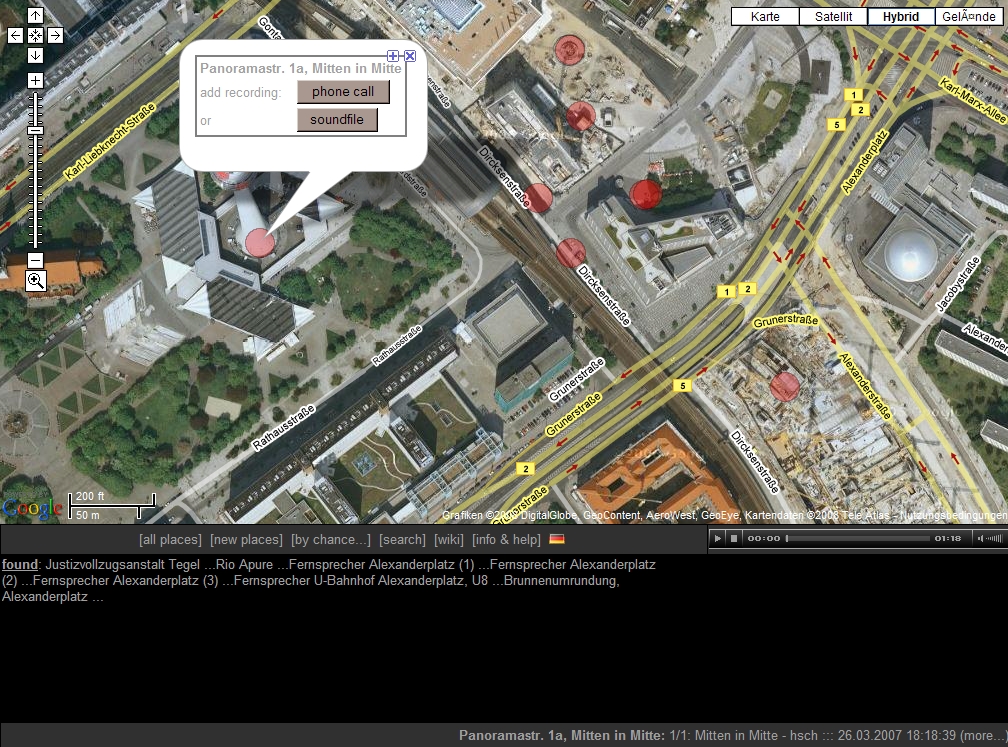
radio aporee ::: maps is an open project about the creation and exploration of public sonic layers. It collects and organizes sound recordings from daily surroundings and living spaces. The audible material is organized within a mashup system of mapping software, databases, telephone networks and the Internet. Sites and sounds can also be explored and accessed in situ by recent GPS-enabled mobile devices.

The project reflects on actual changes and developments in mobile computing and so called locative media, which we assume to be crucial to the way we experience our near future daily life, where media and markets will emerge at the precise position of our body. Whether and how we can create and keep unoccupied spaces aside from predetermined functions and fictions, is an important question to the project.

appearance at Tuned Citypublic and private soundscapes / 03.07.08

Little Helpers

little helpers

acoustic “orientation system” by Will Schrimshaw
all festival locations / 01.07. – 05.07. 08

Little Helpers
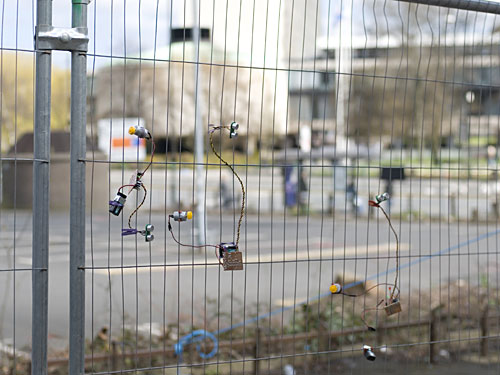
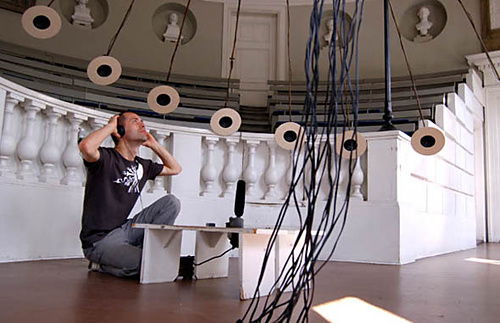
draw attention to the resonant properties of matter. They act as vibrational prostheses, extending and enhancing the material force in sound and its impact upon an environment. They occupy architectural spaces, drawing out the audible qualities of architectures that may ordinarily go unheard.

Bodies moving through a space trigger motors, sounding whatever object they are attached to. Movements acquire a resonant trace. The use of movement as a trigger is intended to initiate performative engagement, drawing passersby into interactive exchange and making audible the impact of their movements upon their immediate surroundings.

Quotidian and interstitial spaces such as pavements, corridors and lifts are the preferred locations for installing Little Helpers. They are autonomous units that can be deployed in almost any location (railings, cupboards, fences, hedges, lampposts…). They require little power to function, using their numbers to make up for what they lack in individual power. Readily available materials such as elastic bands, string and sticky tape are used to fasten them to suitable objects. This enables quick deployment in suitable sites. An installation/occupation can be set up and taken down in a short space of time, without requiring lengthy consultations with property owners or institutional support. Their construction is light and flexible in order to allow a greater range applications within diverse spaces.

Aubry, Gilles (CH/D)

Gilles Aubry is a Swiss sound artist, musician and researcher living in Berlin. His practice is based on a performative approach to field recording, documents and historicalsources, often including collaborations with other artists, musicians and researchers. He critically addresses listening, sound practices, music, technology and environmental voices, examining their relations to power structures and ideologies in various contexts. Using formats such as installation, live performance, film, publication and radio, he creates works that playfully reconfigure materials and discourses into speculative spaces for shared experience and reflection.

www.earpolitics.net


appearance at Tuned City
design of acoustic environments / 04.07.08
Tuned City Messene 2018 – Listening Politics

Noll, Udo (D)

Udo Noll, born in 1966, is a media artist and degreed engineer for film, photography and media technology. He lives and works in Berlin and Cologne. Since the mid 1990s he has worked as an artist and media professional in numerous international projects and exhibitions. Udo Noll is the founder and active developer of radio aporee, a project platform for the artistic research of concepts and applications related to sound, space and place, with focus on field recording and corresponding practices.

artistic & experimental projects / exhibitions / workshops 1996 -2008:
… / Video Art Festival Locarno / documenta10 Kassel / 1st Performance Festival Odense / FriArt Center of Contemporary Art, Fribourg / Palais des Beaux Arts, Brussels / Kunst- und Ausstellungshalle der Bundesrepublik Deutschland, Bonn / World Wide Video Festival Amsterdam / International Art Fair Cologne / ZKM Center for Art and Media Technology, Karlsruhe / Galerie K&S, Berlin / Gallery Brigitte Schenk, Cologne / Orangerie im Volksgarten, Cologne / Musee d’art moderne de la Ville de Paris /De Geuzen, Amsterdam / Villa Medici, Academie de France a Rome / Enkehuset Gallery Stockholm / jonctions 5, Brussels / Atelier Nord, Oslo / Biennale of Architecture, Venice / ISEA, International Symposion of Electronic Art, Paris / Akademie Schloss Solitude, Stuttgart / 25th Bienal de Sao Paulo / 5th biennial for media & architecture, Graz / PS1 New York / Einstein Forum Potsdam / das kleine field recordings festival, Berlin /program – initiative for art + architectural collaborations, Berlin/ art 2.0 Cologne / …

aporee.org/aporee.html

appearance at Tuned City
Brussels / radio aporee – fmwalks/bx / 26–30. June 2013
Tallinn / Radio Miniatures – Radio Aporee workshop / 18-22 April 2011
Tallinn / mobile miniatures / ongoing
Tallinn / radio aporee ::: maps – an open project on the creation and exploration … / 10.07.11
Berlin / public and private soundscapes / 03.07.08

BMB con. (NL)

bmb.con

BMB con. is a performance group working with sound, image, and whatever else they can get their hands on (including you!). They perform with all sorts of things (mirrors, microphones, trees, fire, ice) in all sorts of places (museums, forests, boats, concert halls, water tanks). BMB con. was initially formed in 1989 by Justin Bennett, Wikke ‘t Hooft and Roelf Toxopeus and acted mostly as a fixed trio. Since 2006 BMB con. is a collaboration between a BMB coreduo and different individuals and groups depending on the occasion.

http://www.bmbcon.demon.nl/con/

appearance at Tuned City
opening / 01.07.08
Tuned City Messene 2018 – Listening Politics

Schrimshaw, Will (UK)

Will Schrimshaw is an artist and musician based in Liverpool, UK. He is Senior Lecturer in Music and Sound at Edge Hill University. His research interests include sound, materialism and realism in the arts; FLOSS culture and electronic music; sound in site-oriented art. Will is author of Immanence and Immersion: on the acoustic condition in contemporary art published by Bloomsbury.

http://willschrimshaw.net

appearance at Tuned City
Tuned City Messene 2018 – Listening Politics
Brussels / Lecture-event #2 – Artist presentations
Brussels / Module for a Comprehensive Instrument / 27–30. June 2013
Berlin / Little Helpers

Beckett, James (UK/NL)

James Beckett (b. 1977, Harare, Zimbabwe) graduated from the Technikon-Natal, Durban South Africa, after which he took part in a two-year residency in the Rijksakademie Van Beeldende Kunsten, Amsterdam. Coming from a background of installation, sound has come to develop a more central role in his work. This has been a research-based activity with output ranging from radio documentaries to mock ethnic bands, and museum displays documenting the cultural and physiological effects of noise. The evolution in specific areas of the industrial revolution have also played muse; such as the foundation of synthetic colour manufacture and its relationship to BASF, and the cultural implications of vacuum tubes for the Dutch firm Philips. Without humor his work would appear as mere cynism – it is romance with an inherently rotten subject matter which offers some sort of redemption in a modern world.? He currently lives and works in Amsterdam, The Netherlands.

http://www.jamesbeckett.tk/

Sperrgut

glocke

installation by Nik Hummer
Pfefferberg/City of Berlin / 01.07. – 05.07. 08

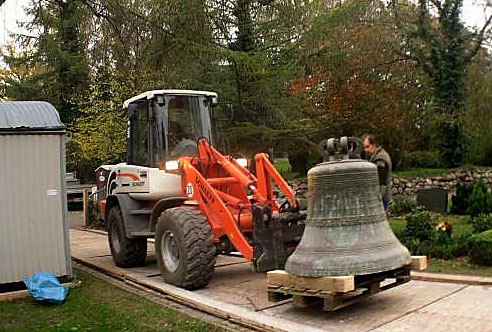
The most important function of a bell is its warning signal effect. The bell as a complex sound phenomenon is thus reduced to its functional coding. Something simular happens nowadays with music in everyday life of urban spaces: PA systems in supermarkets, cafés and sports facilities as well as protable mobile phones reduce complex content to its code in terms of a social affiliation and the communication of states. Sound qualities and optimal listening situations are irrelevant.

Two hundred bells will be sent as a parcel by post and courier service.

Sirens – An Evolution from Water, through Water, to Water

sirens

an exhibition curated by James Beckett
at General Public, Schönhauser Allee / 01.07. – 14.07. 08

Sirens traces the development of the device as an instrument of analysis into the role of auditory alert. As well as a historical account, the exhibition looks at artistic appropriation of the machine in acts which reveal much about the cultural, political and functional aspects of a living device.

In physics, the instrument was developed as a means to illustrate tones, later to develop into the more elaborate and much disputed combination tones, revealing a ‘Klangfarbe’ or timbre. Along with numerous other acoustic instruments, the Siren became a means by which to describe and measure the composite nature of sound, and to some extent demystify the complexity of acoustic phenomena.

The exhibition delineates the development and transformation of the siren, as an idea, an instrument and as a technological device. The artists Andre Avelas, Mark Bain, Ralph Borland, Alec Finlay and Chris Watson, Raviv Ganchrow and Max Neuhaus present their own interpretation of sirens and auditory alerts.

With contributions from SOS Workshop [a collaboration between Leiden University and the Veenfabriek director John Heymans, artistic director Paul Koek], The siren collection of Albert Baas, David Stall, Victory Siren Foundation Inc., and CPSM in cooperation with the Venetian Research Consortium and the University of Verona [represented by Avanzini, F.; Rocchesso, D.; Belussi, A.; Palu, A.D.; Dovier, A].

Featuring artists:
André Avelãs
Mark Bain
Ralph Borland
Alec Finlay and Chris Watson
Raviv Ganchrow
Max Neuhaus

Sirens was first presented 2007 at 66east gallery in Amsterdam.

http://www.generalpublic.de

Grzinich, John (US/EE)

location sound films

As a mixed-media artist, John Grzinich has worked primarily with sound composition, performance and installation since the early 1990s with a focus on site-specific and acoustic sound activity. His work has resulted in numerous performances and projects made throughout Europe and the US. His compositions have been published on a number of CDs on such labels as SIRR (PT), Staalplaat (NL), Edition Sonoro (UK), CUT (CH), CMR (NZ), erewhon (BE), Intransitive Recordings (US), Orogenetics (US), Elevator Bath (US), Pale-Disc (JP), Digital Narcis (JP), and Cloud of Statics(CH). Currently he is a project and media lab coordinator for MoKS – Center for art and Social Practice, an international artist residency center and project space in southeast Estonia.

http://maaheli.ee

appearance at Tuned City
location sound films
Tuned City Nürnberg / 2011
Sound Map of Tallinn / workshop
presentation: Sound Map of Tallinn / 08.07.11
Tuned City Messene 2018 – Listening Politics

kinetic (architectural) modelbuilding

workshop with Ralf Schreiber und Martin Kuentz

Dates: 1-4 July 2008

Fee: EUR 10

Workshop Language: English & German

This four day workshop aims to create architectural models of of urban structures which can be sonically activated using small motors taken from cassette tape players. Each workshop participant can (alone or in groups) develop and build these “sounding (architectural) models”. The models can be tuned according to sound criteria and arranged and linked according to their function for a collective presentation on Saturday 5 July.

The motors can be upgraded with simple, self-made circuits such as amplifiers, mixers, speakers and motor controllers. The sounds of theses motors can then be amplified to produce a wide variety of electronic-sounding noises to animate the structures, and tape-loops can even be played through the structures. The models themselves will be constructed of simple materials such as cardboard, styrofoam, wood and metal sticks, and the natural resonance the materials used has a direct influence on the sound.

No previous experience is required for this workshop, and the models can be taken home by the participants. There is also no age limit for participation. The workshop is limited to 10 participants per day, and you may participate on one, a few or all four days. Early registration is recommended.

please register here

Hearing Berlin: 12 Approaches

watson

workshop with Chris Watson

Dates: 1-5 July 2008

Fee: EUR 75

Workshop Language: English

Hearing Berlin: 12 Approaches is a workshop for environmental sound recording conducted by Watson for Tuned City. This workshop takes a multidisciplinary approach towards field recording, inviting practitioners in different disciplines–from sound artists to architects, city planners to social researchers–a chance to listen to the city of Berlin through Watson’s expert guidance. The results of this 5 day workshop will be presented in the final day of the Tuned City event.

Tune in, listen and record some of the summer sounds of Berlin from a different perspective and varying temporal resolutions. The techniques and ideas will first be presented at a workshop to introduce the idea of working with location sounds, what recordings to aim for and thoughts about application and post production. Different recording equipment will also be described and approaches to listening discussed.Fieldwork will follow at a variety of key locations. One possibility is to explore sites ‘out of hours’ to pick up the underlying atmospheres that characterize familiar city sites, the sounds of which are often masked by the noise of traffic and human activity during the day. Participants will then be encouraged to work with the gathered material in a post production environment to create pieces for installation, demonstration and exhibition later in the week.

No previous experience is required for this workshop, and the use of high quality, professional recording equipment is included. The workshop is limited to 12 participants, so early registration is required.

http://www.chriswatson.net/

>>> this workshop is fully booked!

Scrying

scrying

workshop with Martin Howse

Dates: 1-2, 4 July 2008

Fee: EUR 60

Workshop Language: English

Scrying can variously be defined as a technique of divination or revelation, of producing visions, perhaps of the future, through prolonged gaze at an object, usually of crystal or liquid nature. Scrying was famously practiced by the 16th century astronomer, mathematician and alchemist John Dee with the assistance of presumed impostor Edward Kelley.

Scrying presents the third part in a series of practical workshops examining electromagnetic [EM] substance within the constructed environment. These previous workshops, Maxwell City, in Oslo and, more recently, Demons in the Aether, in Dortmund trace a clear spectrum of concerns, a novel route informed by the work of James Clerk Maxwell, with the notion of entropy and thus ecology bridging physics and information theory; from thermodynamics now into the digital domain.

Scrying thus moves from detection of a twinned EM architecture, a ghost city, through active intervention or transmission, towards an idea of making sense within the social regime of signal and noise. City-wide EM phenomena will be explored primarily from the perspective of a modulated, data space. The demons in the aether, the workshop participants, are transformed into detectors, coherers and detectives, attempting to make sense of an equally ghosted landscape composed of leaked signals and questionable [EVP/ITC] transmissions.

Across three days, the scrying workshop will explore and construct city-wide EM phenomena within the data space domain, examining techniques of digital forensics, of signal archaeology overlapping with contemporary artistic concerns. The scrying platform, an open hardware project concerned with the design and implementation of low power (enabling long-term, solar-powered urban installation) devices interfacing code and EM practice, will be used during the workshop.

On the afternoon of 3 July, Martin Howse will present a public Scrying performance in the area of Alexanderplatz.

Scrying is open to a wide audience of practitioners from fields such as media art, audio art, architecture, contemporary art, and radio. Participants need not have attended a previous workshop, and no previous experience is required for this workshop. Participants will be able to keep the Scrying equipment constructed during the workshop. The workshop is limited to 12 participants, so early registration is required.

http://www.scrying.org

please register here


Storm

storm

performance by Chris Watson / BJNilsen / 05.07.08 / 9 PM / Rundfunkhaus Nalepastraße

“During December 2000 several significant storm fronts developed across the North Sea and Scandinavia. BJ remarked to me that he had recorded some of these on the Baltic coast and proposed a collaborative cd project based around our mutual interests in the rhythms and music created when the elements combine over land and out to sea.

We spent the next few years gathering recordings on our respective coastlines and islands during the very active weather windows during the autumnal equinox and winter solstice. This was focused around our following one particular cyclonic system, which veers over Snipe Point on Lindisfarne to the Isle of May in the Firth of Forth, and finally descends upon Öland and Gotland where Benny listened in with a favourite pair of Sennheiser omnidirectional microphones.” (Chris Watson, Newcastle upon Tyne August 2006)

Labyrinthitis

labyrinthitis

performance by Jacob Kirkegaard

Jacob Kirkegaard has turned his ears inwards for his new work Labyrinthitis, a three-part interactive sound piece that consists entirely of sounds generated in the artist’s auditory organs – and will cause audible responses in those of the audience.

Labyrinthitis relies on a principle employed both in medical science and musical practice: When two frequencies at a certain ratio are played into the ear, vibrations of the hair cells in the cochlea will produce a third frequency. This tone is generated by the ear itself: a so-called “distortion product otoacoustic emission” (DPOAE), referred to in musicology as “Tartini tone”.

By arranging these recordings in a composition and playing them to an audience, the artist evokes further distortion effects in the ears of his listeners. At first, each new Tartini tone can only be perceived individually, inside the head of each member of the audience. Kirkegaard picks it up, reproduces it and combines it with another distorting frequency. Thus another Tartini tone is created. Step by step, a pattern of descending tones emerges – “intersubjectively” in the audience’s ears, “objectively” in the auditorium space. The spiral form of this tonal structure mirrors the composition of resonant spectra in the human cochlea.

http://fonik.dk/works/labyrinthitis.html

diffusion – acoustics

nalepastrasse

performance by Thomas Ankersmit und Antoine Chessex

For Tuned City, Thomas Ankersmit and Antoine Chessex have been invited to perform a series of site-specific acoustic saxophone duets at the former GDR radio studios at Nalepastrasse, which aim to explore the particular sonic phenomenon intrinsic to that location.

das kleine field recordings festival

fieldrec

DKFRF is an ongoing, no-budget event dedicated to field recording and related sound art and electronic music organized by Rinus van Alebeek in some of the most unlikely venues around the city of Berlin. Now in it’s second year, it is coming close to being the most uninstitutional institution in town!

with:
Lasse Marc Riek will liberate the hidden sounds of the city with his ultrasonic microphones. His quest is for places where sounds are unheard.

Richard Francis (aka Eso Steel) has been active as an experimental music composer and improviser since 1996. His work over the years has explored different techniques of sound generation and processing, with a focus on the collection and digital processing of various natural and artificially produced sounds from the surrounding environment.

Harold Schellinx will witness and record the ongoings and report on it once everything is said and done. Schellinx’s performance will take place once everybody has gone home and has returned to their every day duties and pleasures. On the day of the dkfrf itself he will be present with a microphone and his observation skills. His reports will be published in his Soundblog (written and images) and as a sound report on the internetradio raudio.

Soinu Mapa is an open collaboration project. Based on “phonography” or the art of recording of environmental sounds, their aim is to share and exchange fieldrecordings from the Basque Countries. At dkfrf Oier Iruretagoiena and Xabier Erkizia will present Soinu Mapa and use the sounds as a starting point for their performance.

The Phonographic Arkestra
(Wolfgang Dorninger, Richard Eigner, Stefan Messner, Joachim Knoll, Stefan Kushima, Michael Petri, Iduna Sickinger, Johannes Staudinger)

http://kleine-frf.blogspot.com/

active city circuit

active city circuit

performance by Martin Howse

Active City Circuit is a performance within urban space (Berlin) across two locations examining electromagnetic (EM) substance and duration/time scale. The primary performance location (near former Palast der Republik site) will witness the construction of an active circuit divining and making sense of local EM signals transmitted through the earth. Several holes will be drilled in street or pavement, probes inserted with further equipment filtering and amplifying this signal. The signal is inserted within a constructed circuit assembled during the performance using local metal structures, copper tape, and graphite, audibly amplified within local space and connected by way of FM radio transmission with a distant site. This second site will use the architecture of city apparatus as an antenna for the dissemination of local EM emissions. The connection between the two sites maintains a time relation (special relativity, the constant of the speed of light, deep time of radio telescopy), and is subject to the constraints of a city architecture.

Hometown

hometown

by tamtam (Sam Auinger, Hannes Strobl)

Hometown focuses on the locations where our personal urban life takes place and what is special about them. The starting material consists of recordings of urban situations/spaces in Innsbruck, Linz and Berlin. hometown is divided into four movements and a prologue.

prologue: We see this as an introduction to our piece for the listener – a chance to get to know the sound material and our sound vocabulary.

1st movement – spaces: The sound sphere of three urban back courtyards, courtyards of city apartment houses, here becomes a cantus firmus. our interest in terms of composition lies in the communicative quality of these acoustic spaces.

2nd movement – colors: Starting material is recordings of the sound condensations in the urban sound sphere, sounds of the major urban traffic arteries with all of their acoustic phenomena, called forth and distinguished by their architectonic situations … These are burning and friction sounds, modulation, layering, mixing, drone.

3rd movement – rhythm: Rhythms and rhythmical structures that can be experienced every day in public space. The compositional undertaking is nourished by rhythmic patterns of our city life and the polymetry that underlies them.

4th movement – space: The sound material from a concrete urban situation (Berlin, border between Prenzlauer Berg /Wedding) becomes the cantus firmus. all musical and sound aspects of the three previous movements merge here.

voice: David Moss / cello: Michael Moser / bass: Hannes Strobl / sampler: Sam Auinger
duration: 57 min