Xenakis´s sketch of the Diatope, a combination of sound and light effects in a pavilion he designed himself especially for this purpose (Paris/Bonn 1978-1979)
Iannis Xenakis (1922-2001) designed together with Le Corbusier the Philips-pavilion for the 1958 Brussels World Fair. This pavilion is an early example of (“hybrid”) combined media and architectural space.
Xenakis´s ‘material’ architectural work is to be seen in continuity with his architectures of music and light. In this context Xenakis pleads for the development of a “General Morphology”, a research concerned with the understanding of form and its generation.
The lecture gives examples of how the interdisciplinary group Urban Sound Institute, USIT, explores possibilities to construct and shape urban space and discuss the sonic environment. This environment is understood as time-related, changing, multilayered and heterogeneous spaces, immersed with technology and culturally influenced by media such as film and television postproduction. USIT works with sound art projects and acoustic design, combining knowledge in music, architecture and acoustics to investigate how sounds can interact with built structures, places and events to form communicative, shared, relational spaces in cities.
What happens to the notion of ‘space’ and ‘place’ when examined through a sonic lens. Which vocabulary and which concepts exist to talk about sound in public space?
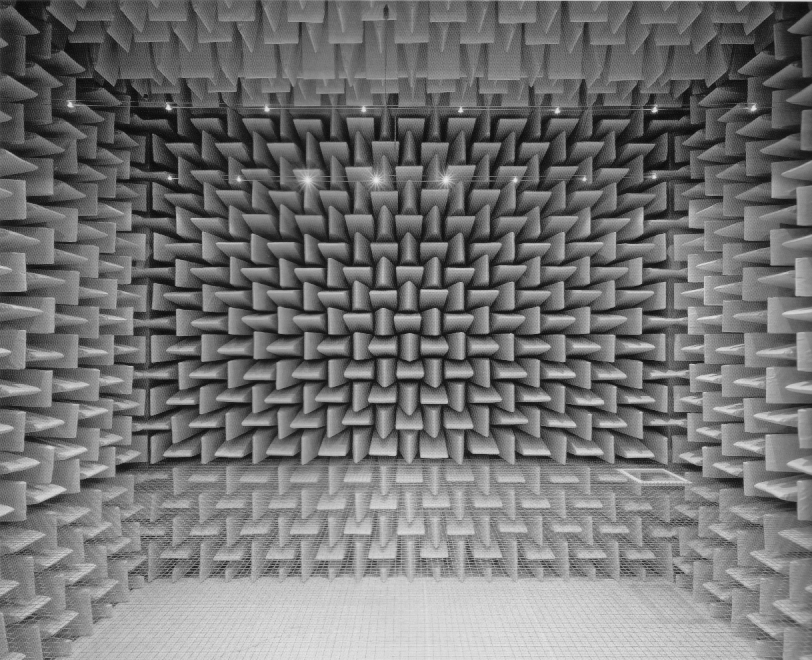
The anechoic chamber ia a room designed to be of high sound absorbency. All surfaces inside the chamber are covered by sound-absorbent materials such as foam. The walls are often covered with inward-facing pyramids of foam, to minimize reflections back into the interior of the chamber. It is used for experiments in acoustics and for testing audio equipment. The anechoc chamber at TU is one of the biggest in germany.
The «Sound-Space TU Berlin» is a permanent, sound installation located in the main building of the Technical University of Berlin. In a cube-shaped passageway cum room in which three corridors meet, Leitner built a sound-absorbing covering, with 42 hidden speakers distributed over the wall surfaces. Leitner sees the space as an electronic instrument from which an immaterial architecture can be retrieved using complex, programmed compositions. In the process, he liquefies architectural qualities such as proportion, tension and weight, by making these characteristics temporal and flexible. In the reverse, the constructional coordinates offer the structures for a musical event. txt: Golo Föllmer
We experience spaces not only by seeing but also by listening. We can navigate a room in the dark, and “hear” the emptiness of a house without furniture. Our experience of music in a concert hall depends on whether we sit in the front row or under the balcony. The unique acoustics of religious spaces acquire symbolic meaning. Social relationships are strongly influenced by the way that space changes sound. In Spaces Speak, Are You Listening? Experiencing Aural Architecture, Barry Blesser and Linda-Ruth Salter examine auditory spatial awareness: experiencing space by attentive listening. Every environment has an aural architecture.
The audible attributes of physical space have always contributed to the fabric of human culture, as demonstrated by prehistoric multimedia cave paintings, classical Greek open-air theaters, Gothic cathedrals, acoustic geography of French villages, modern music reproduction, and virtual spaces in home theaters. Auditory spatial awareness is a prism that reveals a culture’s attitudes toward hearing and space. Some listeners can learn to “see” objects with their ears, but even without training, we can all hear spatial geometry such as an open door or low ceiling.
Integrating contributions from a wide range of disciplines–including architecture, music, acoustics, evolution, anthropology, cognitive psychology, audio engineering, and many others–Spaces Speak, Are You Listening? establishes the concepts and language of aural architecture. These concepts provide an interdisciplinary guide for anyone interested in gaining a better understanding of how space enhances our well-being. Aural architecture is not the exclusive domain of specialists. Accidentally or intentionally, we all function as aural architects.
This talk examines several recent architectural projects in which sound plays a prominent part: these range from projects in which architects apply acoustic or musical notions to the design of buildings, to collaborations between architects and sound artists, some of which seek to blur the distinction between the two disciplines. It considers some of the main issues raised by such projects and whether they manage to achieve a genuine symbiosis between sound and architecture.
The beginnings of architectural theory seem to be steeped in Platonism, modelling construction work on the mathematical harmonics of a divine demiurgos. However, things turn out to be more complicated than that: Vitruvius’ “De Architectura”, the only complete treatise on architecture that has come down to us from antiquity, was clearly influenced by Plato, but also by more earthbound philosophers, and it even remains remarkably close to the dirty work of urban planning and construction. When the focus is shifted accordingly, another scenario emerges from the text: an unusually agonal conception of architecture which describes the city as an instrument of war and as a theatre of memory, commemorating diverse powers and their struggles for hegemony. “De Architectura” stresses that cities grow by the commands of the mighty and that, vice versa, architecture serves to structure and amplify their violent voices. It is only consequential that the text describes the movement of human history as a co-evolution of language and architecture, both imitating and modifying natural phenomena. Architecture is thence described not as a work of imitative cosmic creation, but as an appropriation and modification of nature, an intervention in the conflict of the four elements. In this context, Vitruvius develops the first known exposition of the wave theory of sound in order to deal with the acoustic dimension of architecture and with the properties of machines that can produce, enhance or dampen sounds. While it unfolds military, religious and theatrical dimensions of architectural acoustics, “De Architectura” stresses the relation of the word to the physicality of mere sound and engages on several levels with methods to ameliorate urban soundscapes, so the word of the powerful can spread as unhindered and undistorted as possible. Yet the triumphant Roman speech remains constantly threatened by a wordless, noisy and barbaric past which is both resisted and perpetuated by urban planning. It might be inspiring to listen more closely to these noises from the crypt of architectural theory.
Urban public spaces are changing from being free places of social exchanges and expression into controlled territories.
In a critical approach to the cities’ economic strategies in space production, this presentation addresses on counter tactics and actions with sound as a tool to subvert systems and amplify perception of in-between realities.
The intersection of architectural acoustics and psychoacoustics, the sound dimension is approached in its potential to generate aural interstices, autonomous zones that offer to people momentary situations of sensory experiences and open perceptions.
THE BODY SCALE OF DESIGN TOWARD A SONIC ERGONOMY: A KINESIC APPROACH
Precedent works have shown us that a lot of sonic effects are efficient on short distance. Several researches – in habitations, working places or public spaces, and especially around transportation system – have shown us that adaptative behaviors are necessary to improve the listening of others, direct vocal communication or simply remain waiting, sitting or standing. These uses are based on the skills of each inhabitants to act in different sonic situations. So we have been more interested in working at the space scale of those ambient architectural compounds that imply a direct interaction with the human body. It leads us to think of ordinary urban objects such as doors, places to sit or to wait, shelters. Around such minimal spaces, a whole array of moving modalities linked to the use of voice and hear are identified : bypassing, sitting or leaning modalities going through, crossing a sonic area, rotating. This array of actions which come close to the will of movement make the hearer’s immediate sonic milieu drift. It incites us to imagine what one may do with one’s sonic environment, or more globally, with one’s ambience.
Space and sound are linked by motion. We talk and hear in motion. The sonic design of space could be thank whitin this active dimension in mind. It is to be preferred to the passive conception of hearing in the sonic environment which is usually considered in order to understand how it is appreciated or how it is identified.
AN EXPERIMENTAL APPROACH
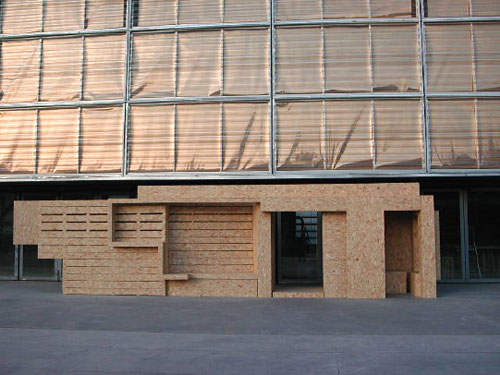
According to these principles, recent experimental models of construction which were built on the scale of the human body in movement, allow us to test design and spatial compounds and potentialities of uses in sonic context. While digital and sophisticated tools are being developed, our experimentations are to a great extent hand-crafted (panels of wood and screws).
Another aspect of these experimentations consists in sonorizing the object in order to create a situation. On a methodological aspect a scenario with several persons (ordinary people, acousticians, partially sighted persons) have been tested.
These experiments can contribute to develop a sensitive ecology of architectural forms.
Our goal was to model a form that creates a situation in which a lot of possibilities of uses are afforded. The prototype is furthermore transposable to other public contexts. This kind of equipment could find its place in different situations: to create a passage between a building and a street, or to offer a furniture in such places as underground public spaces, or big atria where the sonic environment is usually too homogeneous with great reverberation and ubiquity. This equipment could locally offer possibilities to escape these effects.
Spatial structures are the dreams of society. Whenever the hieroglyph of any such spatial structure is decoded, the foundation of the social reality is revealed. (Kracauer)
For the first time in history, the majority of citizens in western culture possess the technology to create their own private mobile auditory world through the use of a range of mobile sound technologies. Contemporary urban culture is one in which we increasingly use communication technologies to control and manage our experience of the urban environment. The automobile, mobile phone and MP3 player have progressively transformed the meaning of what it is like to live in urban culture. Their use represents a fully mediated culture in which increasingly large parts of our experience are constructed through the use of these mobile communication technologies. It is a culture of auditory mobility in which the privatising impulse of Western culture has come to a state of maturity. The use of media technologies and the spaces of the city become intimately intertwined, media use is increasingly amorphous and mobile whilst urban space is largely mediatised. In this lecture I argue that we increasingly live in a hyper-post-Fordist culture in which urban subjects construct what they imagine to be their own individualised schedules of daily life – their own daily soundtrack of media messages, their own soundscape as they move through shopping centres, their own work out sound track as they modulate the movement of their bodies in the gym. Urban subjects increasingly move through space in their auditory bubble, on the street, in their automobiles, on public transport. In tune with their body, their world becomes one with their “sound tracked” movements; moving to the rhythm of their music rather than to the rhythm of the street. In tune with their thoughts – their chosen music enables them to focus on their feelings, desires and auditory memories. The lecture argues that it is no longer possible to adequately understand the nature of urban culture without also understanding the nature and meaning of the daily use of mobile communication technologies.