projects

sonic drainscape – a public research on sonic potentials

Eyland 07 und Florian Tuercke invite you to research on sonic potentials throughout the drainscape of Tallinn´s Old Town.

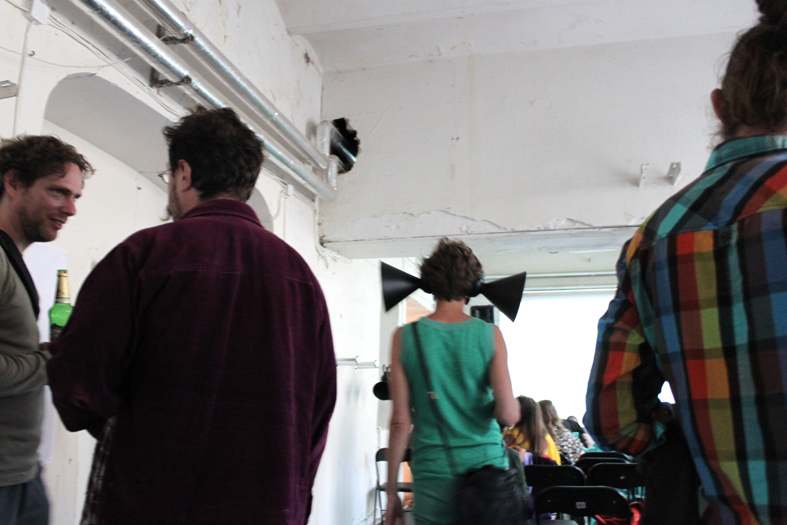
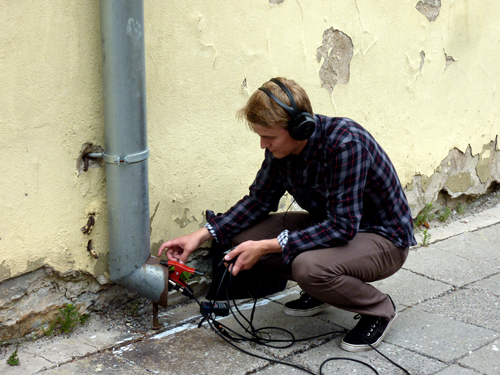
This project focuses on the peculiarities of the Old Town´s drainscape – its different shapes and diameters. The open tubes scattered all over become an agglomeration of open resonant pipes tuned by the height of the buildings. The equipment can be rented at MÄRZ (map >>>). Here you also find a map to mark the locations of your favorite drainscape sounds for others to track them. For further information please see sonic drainscape of Tallinn.

MÄRZ project space is open from 11:00 to 18:00 and for the evening presentations beginning at 20:00. For program information please check out fringe-events

projects

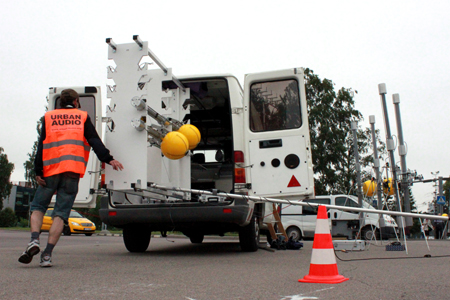
Urban Audio ECoC1 in Tallinn / only today – July 5th

This is a one time event. Don´t miss it!
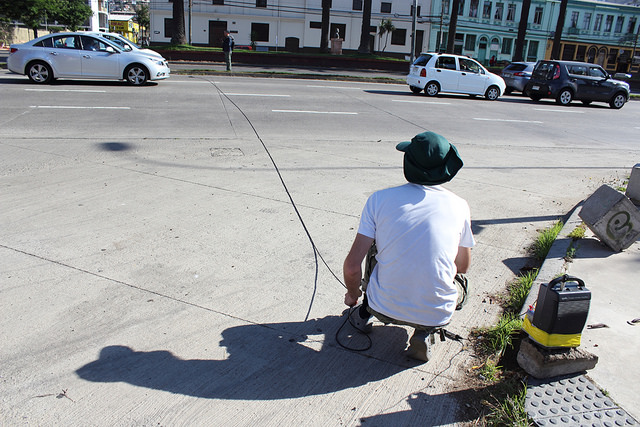
Florian Tuercke (D) is playing the Urban Audio throughout the afternoon of July 5th.
Location: intersection of Põhja Pst/ Sadama (in front of the Statoil gasstation)

The intention of the concept Urban Audio is to examine public space in terms of its musical and compositional potential. For this purpose special instruments are designed that transform ambient sounds to musical tunes. The Urban Audio instruments are temporally put into public places to record music, e.g. at intersections. When a car passes by one of the instruments, the contained strings resonate. The string-vibrations are picked up and transfered to the recording studio via radio-transmission.
The Urban Audio music is created and played by all participants of the underlying noise situation. These music pieces are collateral compositions, which means compositions that are created as by-products of situations whose purpose and origin has no musical substructure.

projects

Tuned City Tallinn – Opening of fringe-events

Tuned City Tallinn started today offering exhibiton, screenings and presentations at MÄRZ project space (fringe-events), as well as a series of guided sound walks throughout the city space. Further, a variety of workshopsare offered. If you are interested in participating in either of them and have not yet registered, please check out the respective site.
The festival´s main program takes place over the week-end, July 7th – 10th. During this time, a diverse program of lectures / presentations, performances / evening concerts, installations, and site-specific projects will be offered to public. A fascinating cross-section of international artists, performers, scientists and thinkers will be brought together to present their approaches to sound and space.

All events are free of charge except the evening concerts. For those you can buy tickets directly on the venue or online >>>. For further information please have a look at the single program categories.

Jaume Ferrete (E)

Jaume Ferrete is artist and coordinator of Sounds of Barcelona, a project initiated by Music Technology Group (Universitat Pompeu Fabra, Barcelona).  He is in charge of the coordination of the development of the project, workshop design and workshop teaching.

www.barcelona.freesound.org

appearance at Tuned City
Sounds of Europe / 08.07.11

projects

tuned city tallinn complete program online

Tuned City in Tallinn / Estonia is about to start.
The complete program for the days 4th – 10th JULY is online now.
Please have a look at the schedule overview and the single program categories; conference / performances / workshops / installations / site-specific projects and fringe events. The printed version of the program can be found here as PDF.
All events are free of charge, except the evening concerts. Fore those you can buy tickets directly that evening at the venues or online now already.
Some of the site-specific projects may require registration to keep the audience within a certain size. Please check the project descriptions and make your reservations early!

[lang_ee]

Tuned City Tallinn on alustamas!
4.-10. juulini kestva festivali programmi leiate nüüd meie veebilehelt.

Palun leidke sealt programm ning eraldi sündmuste kategooriad: konverents / performance‘id / töötoad / installatsioonid / kohaspetsiifilised projektid ning eelsündmused. Prinditav versioon programmist on PDF-ina leitavsiit. Registreerige end varakult!

[/lang_ee]

Artal, Fabien (F)

Fabien Artal lives and works in Berlin. He is particularly interested in relationships between sound devices and space. Recent works are about the development of artificial intelligence-based sound performers.

This research follows several sound performances:

Microloop, “Festival Les Hors-Lits”, Marseille (France), 2011
Inauguration of Vasarely Museum, Pécs 2010 (Hungary)
“Laisser Le Passage Libre” festival, Barnave (France), 2010

appearance at Tuned City
Toposone / 08.-10.07.11

Torpedoes Out

installation by Raul Keller

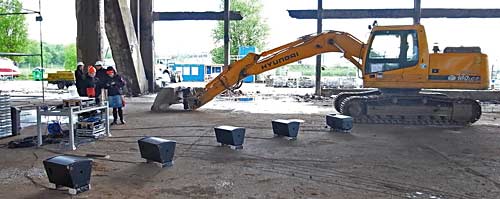
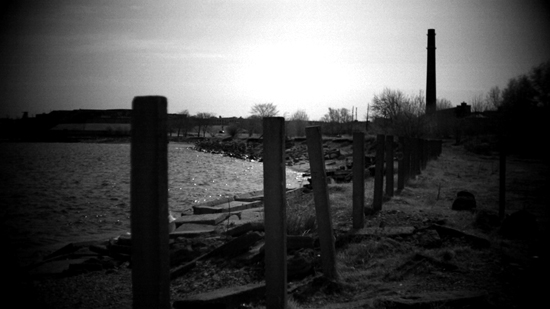
A regular torpedo – as we know – is a cigar shaped, self-propelled underwater missile, fired from a submarine and meant to explode on impact. Some torpedoes were attracted to the target by sound and some by magnetism. These particular torpedoes, on the other hand, are out-of-water, cigar shaped, non-explosive, sound emitting devices that amplify sine waves produced electromagnetically by a wind-driven propeller. They are located close by Patarei (Battery), a former sea fortification of Tallinn, built in the middle of the 19th century and only bombarded once during its short time as a military object of any importance.

appearance at Tuned City
Tuned City Tallinn / installations

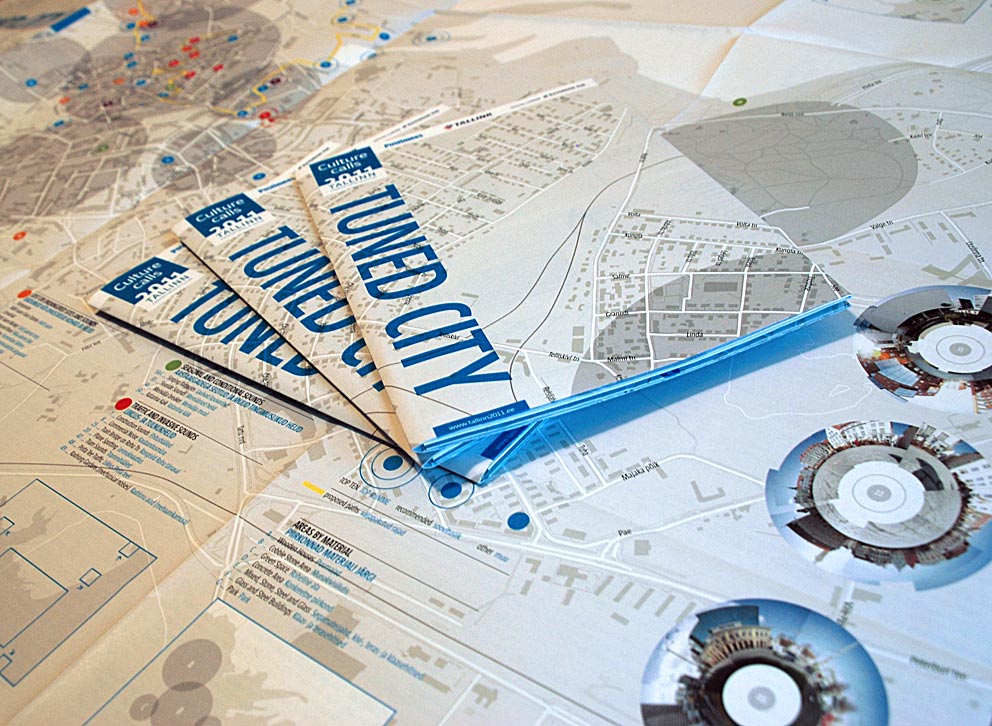
the Sound map of Tallinn

presentation by John Grzinich (US/EST)

While we constantly use our sense of hearing to perceive and navigate through the space around us, we rarely think of how sound can represent spatial experience and in turn, be used to create a visual map for guiding us through the unfamiliar. The aim of this project was to somewhat invert that paradigm and use sound as the basis for offering another perspective on the architectural and social conditions of urban space, both for the foreign visitor seeking cues to hidden aspects of the city and to the permanant resident, who’s familarity with Tallinn overlooks the potential of sonic experience to alter their daily view.

Undertaking such a task does not come without its challenges. The lack of examples of such a map in an analog form (in contrast to the growing plethora of “sound maps” online), meant that we had to invent our own approach for the entire process, from the collection sonified data and then the visualization of that data, to the layout and design of the map itself. For the initial phase we turned to a type of anthropological field work model of filling out forms with written descriptions and marks for relevant categories pertaining to the character and conditions of the sound or sonic effect. This often meant conducting numerous personal and group soundwalks about the city without a clear intent of exactly what we were “looking” for, with the hope that a possible soundmark would fall upon our ears. For this I am grateful to Carlo Cubero and his students at Tallinn University for taking up the task to explore the city in a new way to collect the necessary material. Next came the need to transform and shape the data of our auditory experiences into a usable form as some kind of “map”. Again, cartography of this type did not afford us many examples. While there are an increasing number of surveys on the sonic effects of urban spaces and studies on urban noise across Europe, translating auditory perceptual information into an commonly understandable visual language, still remains a formative science. For this we worked closely with Carsten Stabenow (who seeded the map idea in the May 2010 Tuned City pre-event) and Andreas Töpfer who patiently yet persistently guided us through the extensive discussions and debates of the sound map visualization workshop held at MoKS in April 2011. Without this crucial step it is certain our raw listening experinces would not be communicated in the elaborate but practical manner that you see.

Think of the Sound Map of Tallinn as your Tuned City companion. It is not intended to be a definitvie guide by which we can navigate the city so much as a frame by which one can enter the diverse spaces and life of Tallinn through a particular human sense, one that can disorient us as much as tune us into precisely where we are or isolate and even abuse us in the mediated battleground for our individual listening attention. The map then, serves as an introduction, and can illustrate for us just some of the potential situations in which sound plays an important role in the everyday drama that plays out in urban life. We hope, that those who use this map to seek out our initial findings, become more active listeners themselves and add their own observations and discoveries to what was started within this project.

John Grzinich, June 2011

appearance at Tuned City
Sounding the Local / 08.07.11

fringe events

04.-10.07. 2011, daily 11:00 – 23:00

Tuned City Tallinn will start with a “warm up / fringe” phase. During this time the workshops are running, the permanent and temporary installations in public space and special indoor-locations will be open and a daily schedule of guided audio tours and walks will be offered. Around our main bases MÄRZ project space and Ptarmigan we will establish a social hub for the Tuned City project, with information counter, meeting point, starting location for several walks and guided tours. A fringe program will give the chance to present projects and researches related to our topic in short presentations and Pecha Kucha – style sessions and short performances. Please check our website for most recent program updates.

Info Desk
July 4th – 10th / 11:00 – 23:00
@MÄRZ project space
map >>>

The project space MÄRZ is located in the old town, and focuses on establishing a self-initiated, noninstitutional open cultural project space in the center of Tallinn. You can pick up the program and the sound map of Tallinn here, sign in for guided tours and site specific activities or rent special devices for acoustic exploration on your own. Documentations of several workshops will also be on display.

July 4th 2011

20:00
Project presentation by Florian Tuercke (D)
Florian Tuercke will present his URBAN AUDIO project, the development of the instruments and his experiences during extensive touring with his mobile studio. He will also talk about his work with the Urban Research Institute, dealing with questions of art in public space and artistic interaction with society (http://www.urban-research-institute.org)

21:00
Project presentation by eyland 07 – Jürgen Lehmeier & René Rissland (D)
eyland 07´s field of interest focuses on the peripheral areas of architecture and city planning, often working in interdisciplinary teams together with artists, musicians, specialists for acoustic and sociologists. The relationship of architecture and sound is one of the topics of focus in their work. They will present several projects in this context.

July 5th 2011

20:00
Architectures of Sound: A New Material to Create (in)Habitable Places
presentation by Lorenzo Beretta (IT/UK)
Sound is not just a floating, ephemeral presence that exists in architecture over a period of time but, instead, a solid material that defines and changes the space around us. Sound, through its properties, is able to redefine the way people navigate and explore spaces. Sound is no longer to be used as an accessory or content of architectural spaces but, instead, as a material able to give form, volume and shape to buildings. The talk will provide an historical critical reading of sound over the twentieth-century, the basis for its use as a material and its implications in architectural and design practice.

21:00
Screening: Insound
by Patrick McGinley, Carlo A. Cubero (EE) and students / staff of the Social & Cultural Anthropology Department of Tallinn University
This documentary is a sonic portrait of Kerti, a resident of Tallinn who is visually impaired. The recording follows Kerti doing various tasks of her daily life and includes recordings made by herself.
The piece is an attempt to apply the methodological, epistemological, and ethical standards of ethnography to field sound recordings. The exercise is the result of doing participant observation with a recorder and constructing a sonic argument out of the recordings themselves, using analogous logic to documentary filmmaking. The intention is to consider the properties of sound in their own terms and to use sound as a means to convey a sense of a social experience.
This documentary is the result of a collaboration between students and staff of the Social & Cultural Anthropology Department of Tallinn University and Patrick McGinley, a sound artists based in southeast Estonia. The recorders and producers of this piece are members of a Sensory Anthropology Study Group that meets regularly to research the connections between anthropology and the senses, with a special emphasis on cinema.
Recorders & Editors: Madara Bunske, Marje Ermel, Juhani Juurik, Kerstin Karu, Piibe Kolka, Polina Tšerkassova
Directors: Carlo A. Cubero & Patrick McGinley
Producer & Distributor: Social & Cultural Anthropology Department, Tallinn University

July 6th 2011

17:00 – at Linnahall
Helin/Chime …

[…] Concerts are no longer organised in the Linnahall, which is waiting for better times, but this summer, a sound installation consisting of 10,000 charity chimes will be attached to the ceiling of the pas-sageway under the building. The passageway is 50 metres long and 30 metres wide.
In this manner, the prematurely retired building can offer a sound experience and help for the needy even though its interior is no longer available for public use. The chiming and glowing installation ‘Chime’ is also the imaginary starting point of the Culture Kilometre built for this summer.[…]

The Chime installation is part of the Lift 11 Urban Installations Festival in Tallinn. The work by Juhan Rohtla, Joel Kopli, Koit Ojaliiv only remains a nice idea as the authors misjudged the wind strength and the chime turned out rare and weak. Lift 11 invited Tuned City and the involved artist for a collaborative brainstorming on site for this afternoon.

20:00
A balloon for …
by Davide Tidoni (IT)
A Balloon for … is an itinerant project that brings to life the sound responses of specific spaces. By bursting balloons, the project discovers unique acoustic sites and invites people to explore space through listening. Davide Tidoni will speak about this and several other projects with a particular focus on listening modes and sound experience.

21:00
A soundinstallation for the Katel

project proposal by Maria Hansar and Herkko Labi
From 15th – 17th July Katel/Tallinn will open its doors and introduce Katla’s past, present some valuable ideas for the future and analyze projects that are forming around it. Within the context of this open house, a combination gallery and seminar event will fill two spaces in Katel with site-specific sound and video installations – the grand hall and the so-called secret garden.
Tuned City is honored by the free access given to us by the Katel organizers for our conference and performance program. So when the Katel aproached us and asked if the artists involved in this program could brainstorm about potential options and possibilities, we quickly agreed that this was an excellent idea.
Could something be developed in a workshop during Tuned City? Or could those spaces can be given as an experimental playground and exhibition space? Results of these speculative processes could then be built upon for a follow-up event to the festival.
The organizers of Katel will present the project and look forward to stimulating a vital discussion.

July 9th 2011

ongoing
SONICdust (03:40)
by Lorenzo Beretta
This experimental composition is one of Beretta’s attempts in his ongoing doctoral research to establish how sound alters the behavioural pattern of users in the spatial realm. You are invited to participate through answearing the questions in the book on display.

more to come …
Seaplane hangars

site visit at Seaplane Hangars
July 9th + 10th 2011 daily at 16:00 meetingpoint info center Maritime Museum map >>>
limited places – please register early, see below!

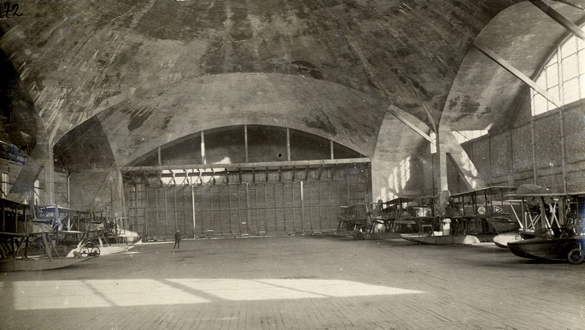
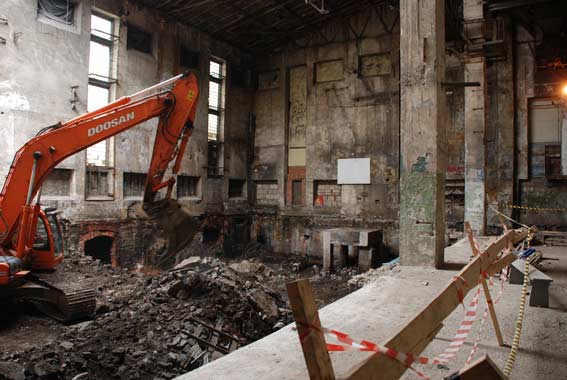
“The seaplane hangars are the most unique architectural monument in Estonia from an engineering and technical point of view,” said KOKO Arhitekid director Andrus Kõresaar. The complex was constructed between 1916 and 1917 and is an unique shell concrete structures, which demonstrate engineering 20 years ahead of its time.
The historic Seaplane Hangar is being renovated and will house the Estonian Maritime Museum. The smooth arced domes of this architectural monument create a series of unparalleled sonic effects, ranging from from pin-point reflections and multiple echoes, to clear signal transmissions across the entire structure. The Hangar was the primary location for the Tuned City pre-events of 2010 where a series of installations, workshops and performances took place. More info on the hangars can be found here: http://www.meremuuseum.ee

[EVENT_REGIS_CATEGORY event_category_id=”005″]

appearance at Tuned City
Tuned City Tallinn / site-specific projects

Linnahall

site visit at Linnahall
July 9th and 10th 2011 – 17:00 meetingpoint Linnahall stairs map >>>
limited places – please register early, see below!

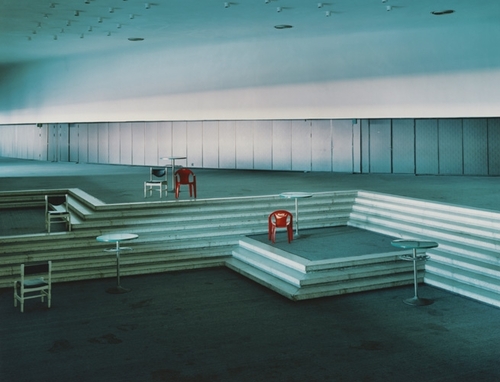
The 22nd Summer Olympic Games were hosted in Moscow in 1980. As inland Moscow had no suitable venue at which to stage the sailing event, this task fell to Tallinn, the capital of then Estonian SSr. Apart from the main venue for the sailing event, Pirita Yachting Centre, a lot of other sports and entertainment facilities were built during preparations for the Olympics. One of them was V. I. Lenin Palace of Culture and Sport, which was later renamed to its present name, Linnahall. A large concrete structure was  built under the obligation not to harm the view from the sea to the old town by architect raine Karp. resembling a Mayan temple from the outside, the inside offers highly interesting architectural ideas. The main auditorium itself has no doors. rather, the complete outer shell can be opened  to the surrounding foyers, exposing the 6000 seats as in a public plaza. Linnahall is no longer used for events, so this is a rare chance to have a look inside.

[EVENT_REGIS_CATEGORY event_category_id=”004″]

appearance at Tuned City
Tuned City Tallinn / site-specific projects

Lippus, Urve (EE)

Urve Lippus (born 1950), Professor at the Estonian Academy of Music and Theatre and since 1990 head of the Department of Musicology. Candidate of Arts (Moscow, 1985); PhD in musicology (Helsinki, 1995). Fields of research: Estonian music history, analysis of texts about music (histories, criticism), performance studies (based on historical recordings), the work and aesthetics of Veljo Tormis, Estonian folk song, modeling musical thinking of the runic song tradition. Principal publications: Linear Musical Thinking. A Theory of Musical Thinking and the Runic Song Tradition of Baltic-Finnish Peoples (Helsinki, 1995), Publications in Estonian Music History (general editor, 8 vols. since 1995).

appearance at Tuned City
Constructing Finno-Ugric identity through music / 08.07.11

Beretta, Lorenzo (IT)

Lorenzo Beretta studied at the Politecnico di Milano (Italy) and Birmingham City University (UK) where he completed his Master of Arts in Interior Design with Distinction. He is now a Researcher at Birmingham City University (UK) completing his Ph.D. investigating the possibility for sound to be used as a material in Architectural Spaces. Lorenzo’s interests include spatial design, sensory architecture and the interactive processes user-space with particular regard to how sound manipulates user perception, cognition and behaviour.

Publications
Beretta, L. and Bailey, P. (2011) Places in Space: How multiple places can coexist within a single space through ambient perception. In Desearch Journal, 1(1). www.desearch.co.uk

Conferences
Beretta, L. (2010) Sonic Materiality | the new frontier in the production of architectural spaces. In: Sound as Art – Sound in Culture. Sound in Theory – Sound in History, held 23-25 September 2010, Aarhus University, Department of Aesthetic Studies, Århus C, Denmark

Beretta, L. (2010) Sonic Materiality. In: Space: the Real and the Abstract, held 04-05 July 2010 at the Centre for Art, Design, Research and Experimentation (CADRE), School of Art and Design, University of Wolverhampton, UK

Guest Lectures
Beretta, L. (2010) Extended ephemeral materiality the use of alternative materials in spatial formation. Somerset College of Arts & Technology, University of Plymouth, Taunton, UK.

Exhibitions
2010 – Ugly Lies, Birmingham City University, Birmingham, UK
2010 – Global Color Trend Forecast Pavillons – NEC, Birmingham, UK

Tidoni, Davide (IT)

Davide Tidoni is an Italian artist and researcher. With a particular emphasis on observation, action and participation, he realizes a variety of works that include site specific interventions and live performances as well as audio projects and listening workshops. He has presented his work at: ARGOS, Centre for Arts and Media – Bruxelles (2015), AFO ArchitectureForumUpperAustria – Linz (2013), In the Field Symposium, British Library – London (2013), Field Studies, Faculty of Architecture and Spatial Design, London Metropolitan University – London (2012), the Barbican Centre – London (2012), STEIM – Amsterdam (2012), Ars Electronica – Linz (2011), Tuned City – Tallinn (2011), the Venice Architecture Biennale (2010), the School of Humanities and Social Sciences, University of Exeter (2009), and RAUM/XING, Bologna (2015).

www.davidetidoni.name

appearance at Tuned City
Tallinn fringe-events: A balloon for… / 06.07.11

On the Plasticity of Echoes: Cold War sites and ruined temples

lecture by Louise K Wilson

Louise K Wilson has traveled inside numerous military and scientific sites in pursuit of the acoustics of resonant spaces. She has sought to explore ways in which technologies of the audible create new ways of engaging with the lost traces of institutional places that are ordinarily overlooked. These investigations have focused on the gathering of impulse responses and the subsequent manipulation of this naturalistic reverberant information. In a recent project with David Chapman, the focus of investigation switched from the capture of environmental information, to the synthetic reconstruction of an environment’s auditory properties – the acoustics of a ruined temple were digitally reconstructed to assist in the production of a soundtrack for a video work that engaged closely with the site.

In her presentation at Tuned City Tallinn, Wilson explores aspects of the tactility of audio technology, the nature of convolution reverb and how Cold War sites resonate with cinematic narratives.

appearance at Tuned City
Sounding the Local / 08.07.11

The Sound of Megalithic Monuments: from Skara Brae to Stonehenge

lecture by Aaron Watson

Neolithic people were the first to use built architecture as a technology for manipulating the senses in extraordinary ways. Between four and six thousand years ago, ritual monuments were constructed across the British Isles from earth, timber and stone. Places such as stone circles and chambered cairns are often spectacular, commanding the landscape and even integrating the movements of the sun and moon. Visual theatre has dominated their interpretation, and they have been understood as silent spaces.
Research is now suggesting that these monuments have acoustic properties. Their architecture is conducive to dynamic echoes and resonant frequencies, and some may have been situated in response to sounds in the wider landscape. When people gathered at these places, monumental sounds would not only have reinforced events but might also have evoked otherworldly forces and dimensions.
From the Neolithic houses of Skara Brae to the vast megaliths of Stonehenge, dynamic soundscapes could have been used to control and transform experience. This not only challenges the dominance of the visual in archaeology, but can also influence the ways in which we engage with the built environment in the modern world.

appearance at Tuned City
Social Acoustemologies: Hearing Contexts / 09.07.11

Resonant Chambers, Broadcast Spheres

image: ETH-Bibliothek Zürich, Bildarchiv
lecture by Sabine von Fischer

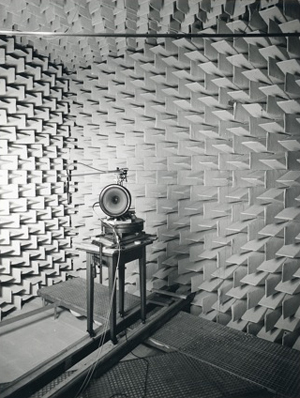
Architectural Acoustics as a scientific discipline emerged parallel to the advent of Modernism in architecture as well as of objectivity in the material sciences. The emergence of means and methods by which the performance of sounds could be measured, predicted and controlled, changed not only the ways by which houses, apartment buildings and workspaces were constructed, but also the ways in which they were perceived. Interior climates, including the auditory environment, became commodified and an individual choice. This condition however required that interior spaces were acoustically insulated and isolated from their surroundings. The hypothesis of this presentation is that these insulated spatial configurations have their roots in the practice of acoustic laboratory tests. At the same time, loudspeaker techniques as developed in the electro-acoustic laboratories laid the basis for reconnecting these isolated spaces. These practices of insulating and again linking interior spaces eventually overturned the modernist paradigm of transparency and set the basis for capsule-like spaces where sound is a private and intimate matter, personalized and subject to a momentary mood – as opposed to the idea of space as static and timeless.

In this presentation, drawing on examples from the history of architecture, von Fischer positions the concept of resonant space of the early acoustical laboratories alongside the concept of electro-acoustically amplified space as it emerged since the post-war period.

appearance at Tuned City
Transduced Spatiality / 10.07.11