Eloquent Voice: Lies and Other Truths

Zoë Irvine (UK)

This sound work is exploring oral history recordings from the BNA-BBOT archives, an online open-access database that has been facilitating inhabitants of Brussels to record and upload their conversations. Voice is a threshold phenomenon, oscillating between the bodily interior and exterior. It is spanning the emotional and the linguistic and extending from the individual to the social. In the work Lies and Other Truths, Zoë Irvine uses biometric voice analysis technology to examine the emotional content of the material voice in forensic detail. It is an experimental work placing the voice in a new light.
Eloquent Voice has been kindly supported by DJCAD, University of Dundee.

[lang_nl]Dit werk verkent flarden mondelinge geschiedenis uit het archief van BNA-BBOT, een databank met gesprekken van Brusselaars. Met de stem als scharnier tussen de wereld binnen en buiten het lichaam, tussen het individuele en het collectieve, analyseert Zoë Irvine in Lies and Other Truths het wezen van het spraakvermogen tot in het kleinste detail.[/lang_nl]

[lang_fr]Cette œuvre explore des bribes d’histoire orale des archives de BNA-BBOT, une base de données de conversations de Bruxellois. La voix est la charnière entre le monde à l’intérieur du corps et l’extérieur, entre l’individuel et le collectif. C’est ainsi que Zoë Irvine analyse dans Lies and Other Truths l’essence de la parole jusque dans le détail.[/lang_fr]

appearance at Tuned City
Brussels / Operative Atmospheres – 30. June 2013

Nessi, Margaux (BE)

Margaux Nessi (BE) graduated in scenography at the National School of Visual Arts of La Cambre. She currently works for theater, film and museums and created for example the set design for La Maison dans la Forêt of the theatre company Welcome to Earth. She also designed masks for the film Never Die Young of Pol Cruchten and conceptualized the scenography of the exhibition of “Haren Visité”.

appearance at Tuned City
Brussels / Haren visité / 30. June 2013

Goryn, Alexia (BE)

Alexia Goryn (BE) is photographer. Her work often originates from places with specific histories or amongst local populations in Europe and Africa. With the images she collects and captures, she develops a discourse around a given location or territory. In 2012 she presented her exhibition “Haren Visité” in Haren and in 2013 she will be presenting it in Brussels.

appearance at Tuned City
Brussels / Haren visité / 30. June 2013

Gillié, Flavien (BE)

The work of Flavien Gillié (BE) is dedicated to field recording. He often connects aspects of a particular place to the sound of the voice and snippets of memories. He elaborates his registrations and recordings until they become sonic landscapes that are suitable for presentations in concert or installation formats.

appearance at Tuned City
Brussels / Haren visité / 30. June 2013

Haren visité

exhibition by Flavien Gillié, Alexia Goryn & Margaux Nessi (BE)

In his essay “Discovering the vernacular landscape” John Jackson Brinckerhoff defines the vernacular, political and emerging landscape. These landscapes overlap, juxtapose and form what Sébastien Marot calls hyperpaysage. In the context of Haren – previously a mecca for chicory production – landscape traces of industrialization contrast with a rural center. Interviews with former residents have been recorded. With the help of locals and institutions of the City of Brussels, images and impressions reappeared, synchronously providing a reality of the past. Since 2010, two photographic sets have been made to account for the Haren vernacular landscape.

[lang_nl]Literatuur over architectuur en stedelijke planning onderscheidt verschillende types landschappen. Haren – een ingesloten dorp met een roemrijk verleden in witloofteelt – kenmerkt zich door een geïndustrialiseerde en tegelijk rurale aanblik. Dankzij lokale bewoners brachten twee fotoreeksen in samenwerking met geluidskunstenaar Flavien Gillié het verdwenen verleden van de plaats terug in kaart.[/lang_nl]

[lang_fr]La littérature sur l’architecture et l’urbanisme distingue différents paysages. Haren – un village renfermé avec une riche histoire de chicons – se caractérise par une impression industrielle et rurale. Grâce aux habitants, deux reportages photos en collaboration avec l’artiste sonore Flavien Gillié ont redessiné la carte du passé disparu des lieux.[/lang_fr]

appearance at Tuned City
Brussels / Operative Atmospheres – 30. June 2013

bx – bROADCAST BOx and other radio aporee tools

Udo Noll (D)

Over recent years, and thanks to a broad community of artists, phonographers and individuals working with sound and field recording, the radio aporee ecosystem has collected and developed both an extensive body of sound as well as tools for artistic practices and research in the field.

In addition to aspects of collecting, archiving and sound-mapping, the radio aporee platform also invokes experiments at the boundaries of different media, and public space. Within this notion, radio is both a technology in transition and a narrative. It constitutes a field whose qualities are connectivity, contiguity and exchange. Within this, concepts of transmitter/receiver and performer/listener may become transparent and reversible.

During Tuned City Brussels, Udo Noll will accompany the course of the festival with his experimental radio device bx (bROADCAST BOx), a hybrid assembly of tools and techniques for entering and exploring different media spaces more or less simultaneously. The bx is an advancement of the previous concept of fmwalks, a setup combining performative city walks and mobile FM transmitting. It creates a link between the radio aporee soundmap of Brussels, recent recordings from actual city surroundings and live activities at various festival venues. It delivers a daily sound stream in between documentation and artistic radio practice, embedded into the city’s urban atmospheres.

According to its notion of an interface, fmwalks/bx is open for participation. It encourages engagement and collaboration with the other Tuned City projects and artists. During festival hours, transmissions can be received on http://radio.aporee.org.

[lang_nl]Tijdens Tuned City Brussels levert Udo Noll via zijn experimenteel radiotoestel bx (bROADCAST BOx) een bijdrage om verschillende mediale ruimtes min of meer gelijktijdig te verkennen. Opgevat als een vervolg van zijn fmwalks, combineert bx de geluidskaart van Brussel met recente stedelijke opnames en de klank van live-activiteiten op verschillende festivallocaties.[/lang_nl]

[lang_fr]Pendant Tuned City Brussels Udo Noll contribue à explorer au même temps des espaces différents avec son radio expérimental bx (bROADCAST BOx). Suite à ses ‚fmwalks‘, bx combine la carte sonore de Bruxelles avec des enregistrements urbains récents et des sons des activités du festival. [/lang_fr]

appearance at Tuned City Operative Atmospheres – 30. June 2013

Urban Ambiances as Sensory Lifeforms

lecture by Jean-Paul Thibaud (F)

What does urban ambiance tell us about current sensory lifeforms and ways of living together? In order to answer this question we need to develop a socio-aesthetic approach of urban ecology. Working towards such a sensory reading of city environments involves closely observing changes underway. In addition, it also involves taking a critical look at their effects and implications. This lecture will therefore highlight the topic of urban ambiances as sensory lifeforms. We will be concerned with the future of urban public spaces and of conceptions about our ability to live in a shared and common world.

[lang_nl]Wat vertelt de sfeer in een stad over hoe men erin samenleeft? Een sociaal-esthetische aanpak van stedelijke ecologie kan alvast een antwoord bieden. Deze lezing berust op observatie van onderhuidse veranderingen en een kritische blik op hun effecten. Ze biedt inzicht in de toekomst van stedelijke publieke ruimtes en opvattingen over het leven in een gedeelde wereld.[/lang_nl]

[lang_fr]Que dit l’ambiance d’une ville sur la vie commune? Une approche sociale et esthétique de l’écologie urbaine peut nous fournir la réponse. Cette lecture repose sur l’observation des changements sous-jacents et sur l’étude critique des effets. Elle offre une vision du futur des lieux publics urbains et des idées sur la vie dans un monde partagé.[/lang_fr]

appearance at Tuned City
Brussels / Operative Atmospheres – 30. June 2013

Earworm

lecture by Timothy Morton (US)
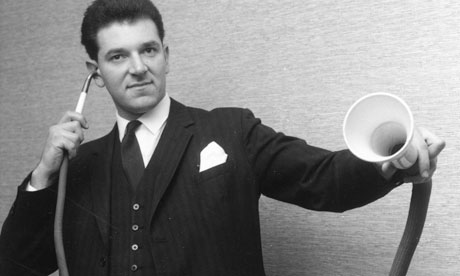
We’ve all heard earworms, those irritating tunes or parts of tune that seem to live rent free in our heads. Why do they do that? Answering that it’s because they are so compelling begs the question. How and why are they so compelling? In this talk I’m going to explore the strange, loopy logical structure of earworms, and explain why it’s better not to try to get rid of them, but rather to coexist with them and possibly embrace them.

A sentence has its own logical DNA, and is mind independent. It is a kind of entity, an “object” in the terminology used by Object-Oriented Ontology. Likewise, a sentence has its own grammatical, syntactical and sonic genome. In this sense, a sentence is like a virus. Viruses are chronologically subsequent to bacteria, in evolutionary time. But they are logically prior, since they encapsulate the strange loop that exists between a physical system and a semiotic one.

In the same way, what is called a riff (sruti, lick, chop) has its own logical, semiotic and physical DNA. A sound, considered in this sense, is like a virus—which is why the term earworm is highly appropriate. We could think of ideas as viral structures for which minds are vectors. In the same way, earworms are spread by humans and other related vectors, such as MP3 players. Riffs are logically prior to the tunes (and so on) in which they find themselves.

This means that distinctions such as natural/unnatural, sound/noise and so on fail when subjected to enough analytical or musical pressure. This failure is not due to the fuzziness of (human) perception or subjectivity, or the context in which sounds appear. This failure has to do with the deep ontological structure of entities as such: they are riven from within between what they are and how they appear, even to themselves.

It is better to think sounds as entities in their own right, coexisting in an ecology of sonic hosts and parasites, in which the host/parasite distinction is neither thin nor rigid. My talk examines the implications of thinking this way. Ambient phenomena are an ideal way to probe this thought.

[lang_nl]Iedereen heeft wel eens een oorworm, dat vervelende deuntje dat maar niet uit het hoofd verdwijnt. Hoe zit het verschijnsel in elkaar en waarom is het zo stringent? Timothy Morton verkent tijdens deze lezing de logische structuur van “akoestische jeuk”. Hij legt bovendien uit waarom men er zich beter niet van probeert te ontdoen.[/lang_nl]

[lang_fr]Nous avons tous parfois ce petit refrain en tête qui ne nous lâche pas de la journée. Quel est donc ce phénomène et pourquoi est-il aussi accaparant? À travers cette lecture Timothy Morton part à la découverte de la structure logique du “fourmillement acoustique”. Et il explique pourquoi il ne faut surtout pas essayer de s’en débarrasser.[/lang_fr]

appearance at Tuned City
Brussels / Operative Atmospheres – 30. June 2013

Aesthetic of Atmospheres

keynote lecture by Gernot Böhme (D)

In this lecture about atmospheres, Gernot Böhme will lay out the cornerstones for the discussion of ephemeral qualities of place. Ecological aesthetics in the acoustic realm is not an embellishment of natural science-based ecology, but acquires its own métier, namely the recognition, the maintenance and the structuring of acoustic space. The question of what constitutes a human environment becomes a question inquiring the character of acoustic atmospheres. And here too it is a matter of overcoming the narrow natural science based approach which remains at best capable of grasping noise as a function of decibels, and to ask instead what type of acoustic character the spaces in which we live should have.

[lang_nl]In deze lezing bespreekt Gernot Böhme de efemere kwaliteiten van een plek. De ecologische esthetiek van akoestiek volgt eigen wetten die om een specifieke aanpak en benadering van de ons omringende ruimte vraagt. In plaats van stil te staan bij de traditionele natuurwetenschappelijke insteek, stelt hij de vraag naar welk karakter onze akoestische omgeving moet hebben centraal.[/lang_nl]

[lang_fr]Dans cette lecture Gernot Böhme étudie les qualités éphémères d’un lieu. L’esthétisme écologique de l’acoustique suit ses propres lois et requiert une approche spécifique de l’espace qui nous entoure. Au lieu de s’arrêter sur le volet traditionnel des sciences naturelles, il se demande quel caractère notre environnement acoustique doit posséder.[/lang_fr]

appearance at Tuned City
Brussels / Operative Atmospheres – 30. June 2013
Penumbra

David Maranha & Patricia Machás (PT)

The optical phenomenon penumbra is a partial shadow, as in an eclipse, between regions of complete shadow and complete illumination. This work alludes to it and deals with the projection of light and sound in its simplest form and in a specific architectural space. It builds itself on the relationship between time and space in a circular process where the sound echoes in the location structure and is simultaneously feed by it. The light, like a magnifier, reveals and defines the focus as a drawing, in an ambiguous space made of light and shadow: “…and then, when darkness arrived, and the sound of silence became perceptible, I could see…”.

[lang_nl]Penumbra is binnen de optica het gedeelte van een schaduw waarin de lichtbron niet helemaal afgedekt is. Dit werk maakt er een zinspeling op en behandelt de projectie van licht en klank op de meest eenvoudige manier in de uitgekozen architecturale ruimte. In een circulair proces galmt geluid in de omgeving en wordt tegelijk door de omgeving gevoed.[/lang_nl]

[lang_fr]Penumbra est au sein de l’optique la partie de l’ombre dans laquelle la source de lumière n’est pas totalement recouverte. Cette œuvre y fait allusion et traite la projection de lumière et de sons de façon dénudée dans l’espace architectural choisi. Dans un processus circulaire le son retentit dans son environnement qui l’alimente.
[/lang_fr]

appearance at Tuned City
Brussels / Situational Listening – 29. June 2013

Sonata For 4 Cardinal Points

performance by Franziska Windisch (BE)

This 30-minute performance is conceived for one performer and mobile loudspeakers. Franziska Windisch discloses what will happen as “public is the voice, public is the step, public are all sounds, under an open sky”. Therefore, Sonata For 4 Cardinal Points paces along the thresholds of a sensitive sphere and interacts with its changing dimensions: the public. Eventually emerged from spoken words, the performance is constantly altering through individual walks and expanding by the noises that reach our ears, as a zone that is never static.

[lang_nl]Deze performance voor één performer en mobiele luidsprekers onthult wat er zal gebeuren wanneer het publiek “stem en stap” temidden van alle geluiden is. Sonata For 4 Cardinal Points ontvouwt zich vanuit gesproken woorden. De voorstelling is als een dynamische zone die onophoudelijk wijzigt door individuele wandelingen en geluiden die onze oren bereiken.[/lang_nl]

[lang_fr]Cette performance pour 1 artiste et enceintes mobiles dévoile ce qui se produira lorsque le public devient “voix et pas” au milieu des sons. La Sonata For 4 Cardinal Points se développe à partir de la parole. La représentation est comme une zone dynamique qui change sans cesse par les déplacements individuels et les sons qui nous atteignent.[/lang_fr]

appearance at Tuned City
Brussels / Situational Listening – 29. June 2013

Soundwalk Passacaglia

Guy De Bièvre (BE)
Meeting point: Maison du Peuple, start 12:30 and 18:00h
limited places – registration required, see below!

The sound-walk Passacaglia is an attempt to cast the urban sound-walk into musical form(s) by playing with time and motif or repetition and other, more detailed musical parameters. Passacaglia is a serendipitous reference to the Spanish origin of the word “streetwalk” and also “a” musical form that originated in the early seventeenth-century Spain and is still used by contemporary composers. It is usually of serious, slow character and often, but not always, based on a bass-ostinato and written in triple meter.

[lang_nl]De geluidswandeling Passacaglia vat het concept van geluidswandelen in een muzikale vorm samen door een spel van tijd, patroon en andere muzikale parameters. De titel Passacaglia verwijst naar de Spaanse oorsprong van het woord en de gelijknamige muzikale vorm die componisten sedert eeuwen boeit en doorgaans van een ernstig karakter getuigt.[/lang_nl]

[lang_fr]La promenade sonore Passacaglia résume le concept de la promenade sonore sous une forme musicale au travers d’une interaction du temps, d’une structure et de quelques autres paramètres musicaux. Le titre réfère à l’origine espagnole du mot et à la forme musicale souvent sérieuse du même nom qui passionne les compositeurs depuis des siècles.[/lang_fr]

appearance at Tuned City
Brussels / Situational Listening – 29. June 2013

[EVENT_REGIS_CATEGORY event_category_id=“006″]

Walk

Stalker/ON

Stalker proposes experimental strategies for intervention. The methodology is rooted in exploratory spatial practices, using playful, convivial and interactive tactics that relate to an environment, its inhabitants and their local culture. Practices and methods are conceived to catalyze and develop evolutionary and self-organizing processes. The traces of interventions constitute a sensible mapping on the complexity and dynamics of the territory. In addition, the applied strategies employ unedited forms of cooperative documentation to contribute and promote a better self-awareness of the community among locals. In the Brussels context, the walk of Stalker will be guided by “unusual” guides. Specific target groups will accompany the audience to see the city through their gazes.

[lang_nl]Stalker hanteert experimentele strategieën voor stedelijke interventie. De methodiek is speels en interactief teneinde een gekozen omgeving en haar bewoners maximaal te betrekken. Wandelingen katalyseren steevast processen van lokale zelforganisatie die via collaboratieve documentatieprocessen een neerslag krijgen. In Brussel nemen bijzondere doelgroepen u als gids mee op pad.[/lang_nl]

[lang_fr]Stalker utilise des stratégies expérimentales pour l’intervention urbaine. Cette méthodique est enjouée et interactive afin d’engager au maximum un endroit choisi et ses habitants. Les promenades catalysent des processus d’auto-organisation au travers de processus de documentation collaboratifs. En Bruxelles, des guides hors du commun vous prennent par la main.[/lang_fr]

appearance at Tuned City Situational Listening – 29. June 2013

Extended transducers and low tension small motors

installation by Pierre Berthet (BE)

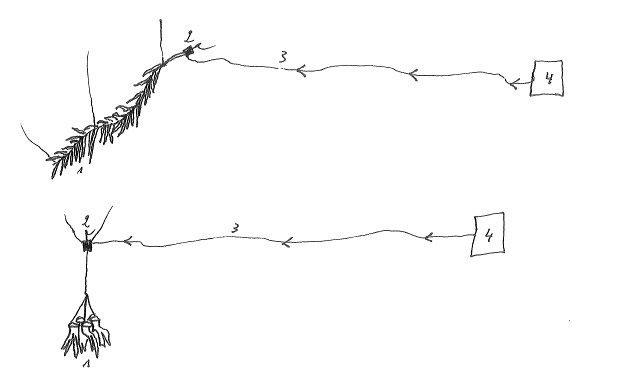
This site-specific sound installation explores various ways to shake, vibrate and resonate dead plants and metal cans, eventually linked through steel wires nets. The length of the wires and the location of the chosen materials are adapted to the dimension of the environment. Transducers and small motors are integrated in the construction. Their movements and sounds make the wires vibrate. When these sounds are modulated (pitch, timbre, volume or density) the combined organic materials and cans produce various resonances. The sound installation is suspended so that listeners can circulate and choose different listening perspectives. Thanks to Patrick Delges (Centre Henri Pousseur).

[lang_nl]Deze locatiegebonden klankinstallatie onderzoekt uiteenlopende manieren om afgestorven plantmateriaal en metalen blikes aan het schudden, trillen en resoneren te brengen. Transducers en kleine motoren brengen de met draden verbonden elementen in beweging tot er geluid ontstaat. De presentatie van het werk nodigt bezoekers uit om eronder door te wandelen en verschillende luisterperspectieven te kiezen.[/lang_nl]

[lang_fr]Cette installation sonore sur site étudie les différentes manières de faire vibrer et résonner du matériel végétal mort et des canettes. Des transducteurs et de petits moteurs mettent en branle des éléments reliés par des fils pour créer du son. Cette œuvre invite les visiteurs à passer sous elle et à choisir différentes perspectives d’écoute.[/lang_fr]

appearance at Tuned City
Brussels / Situational Listening – 29. June 2013

Closer

Roberta Gigante (BE)

This intervention is about discovering urban acoustics. It brings the audience to the space with which it coexists on a daily basis, but of which it has no knowledge. Thanks to the uniqueness and buzz of the chosen place, the transition from a real world to a completely transformed reality takes place. Brussels is a layered city with a particular topographical formation. Its hidden, chthonic dimensioning can lead to another end of urban experience in which the body of each takes the utopian place of actual sensors. The visitor will be invited to enter the place and be confronted with escaping so invisible images.

[lang_nl]Dit werk laat het ontdekken van stedelijke akoestiek toe, een topic waarover het publiek weinig weet. Dankzij het unieke karakter, de gelaagdheid en de drukte van de gekozen plek, illustreert Closer hoe een transformatie van een locatie kan overgaan in een getransformeerde realiteit. [/lang_nl]

[lang_fr]Cette œuvre nous fait découvrir l’acoustique urbaine, un thème que le public connaît peu. Grâce au caractère unique, aux différentes couches et à la foule sur place, Closer illustre comment la transformation d’un lieu peut passer à une réalité transformée.[/lang_fr]

appearance at Tuned City
Brussels / Situational Listening – 29. June 2013

As Far As Your Tortoise Goes

Rie Nakajima (JP)

This site specific project has been tailored to the Ixelles Cemetery. Located in Ixelles in the southern part of Brussels, this cemetery is one of the major cemeteries in Belgium as it contains the graves of a number of famous Belgian personalities. As Far As Your Tortoise Goes includes compositions of sounds, objects and images that need to be experienced in the unique environment of the site. The work has been initially inspired by the grave of Marcel Broodthaers: he is buried at the Ixelles Cemetery under a tombstone of his own design. With this project, Rie Nakajima intends to observe the relationship between the physical and non-physical as well as the objective and subjective matters in our lives.

[lang_nl]De Begraafplaats van Elsene vormt het decor van dit locatiegebonden project. As Far As Your Tortoise Goes bevat gecomponeerde geluiden, voorwerpen en beelden die men hier moet beleven. Geïnspireerd door het graf van Marcel Broodthaers, onderzoekt Rie Nakajima de relatie tussen het fysieke en niet-fysieke, alsook tussen de objectieve en subjectieve aspecten van het leven.[/lang_nl]

[lang_fr]Le Cimetière d’Ixelles forme le décor de ce projet sur site. As Far As Your Tortoise Goes comprend des sons composés, des objets et des images à vivre ici. Inspiré par la tombe de Marcel Broodthaers, Rie Nakajima étudie le rapport entre le matériel et l’immatériel, ainsi qu’entre les aspects objectifs et subjectifs de la vie.[/lang_fr]

appearance at Tuned City
Brussels / Situational Listening – 29. June 2013

Les porteurs

intervention by Sybille Deligne & David Zagari

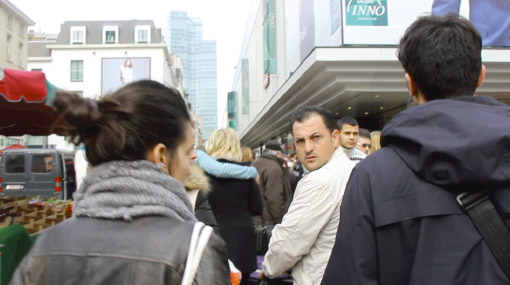
Mobile phones allow us to be reachable at any time. They give us the opportunity to physically escape from where we are. In addition, they have become an indispensable tool for most people and are devices of control as well as geo-localization. As mobile phones emit radio waves with a very low frequency, those waves are inaudible to the human ear. The action of Les Porteurs consists of three performers interfering with the masses of walking people. Devices detecting low frequency emissions will be amplified by using loudspeakers. This action interrupts the flow of the arteries playing back the ubiquitous Hertz.

[lang_nl]Dankzij mobiele telefoons zijn we steeds bereikbaar. Ze hebben intussen de status “onmisbaar” verworven en kenmerken zich door de lage, zelfs onhoorbare, golven die ze uitsturen. De drie performers van Les Porteurs dringen met hun acties een wandelende mensenmassa binnen. Ze sporen er lage frequenties van mobieltjes op om ze vervolgens te versterken.[/lang_nl]

[lang_fr]Les Porteurs ont sur eux un outil pour détecter les fréquences basses émises par les téléphones portables, et tout en les amplifiant de manière ambulante, interrompent le flux des foules dans les zones commerciales urbaines. [/lang_fr]

appearance at Tuned City
Brussels / Situational Listening – 29. June 2013

The city Tunes Itself

Lee Patterson (UK)

The City Tunes Itself explores the hidden sounds of the city – not the sounds that bounce off it’s many surfaces but the vibrations within it’s materials and structures. Presented in four parts on media players and headphones or available as a download, each movement is composed for located listening in specific parks and gardens in the south of Brussels, with the sounds gathered from the surrounding areas. Urban features such as tram pylons, metal railings and sign posts act as tuning forks embedded into the city’s fabric, filtering its‘ sounds according to their resonant properties. Electro-magnetic fluctuations from passing cars and trams feature alongside the sounds of co-existent organisms such as plants, birds and fish. The City Tunes Itself reveals the musicality and inefficiency of energy flow through the urban environment as sound energy is transformed by the city’s resident materials. To the roadside railing or lamp post, a passing car or tram is like the bow to the violin.
[lang_nl]Deze wandeling onthult de verborgen geluiden van de stad. Vier onderdelen zetten aan tot luisteren in specifieke parken en tuinen in het zuiden van Brussel. Typische stadsgeluiden treden in dialoog met natuurlijke organismen die zich in dezelfde omgeving bevinden. Het werkt illustreert de muzikaliteit en klankenergie van de stad door stedelijke elementen gericht in te zetten.[/lang_nl]
[lang_fr]Cette promenade dévoile les sons cachés de la ville. Quatre éléments incitent à l’écoute dans des parcs et des jardins spécifiques au sud de Bruxelles. Des sons typiques de la ville entrent en dialogue avec les organismes naturels qui les entourent. L’oeuvre illustre la musicalité et l’énergie des sons de la ville par l’utilisation réfléchie des éléments urbains.[/lang_fr]

appearance at Tuned City
Brussels / Situational Listening – 29. June 2013

Oto-date

Akio Suzuki (JP)
various locations, to be visited any time: description and map

only 29. June 2013, 17:00h – guided tour by Akio Suzuki
starting location at Maison du Peuple map >>>

limited places – registration required, see below!

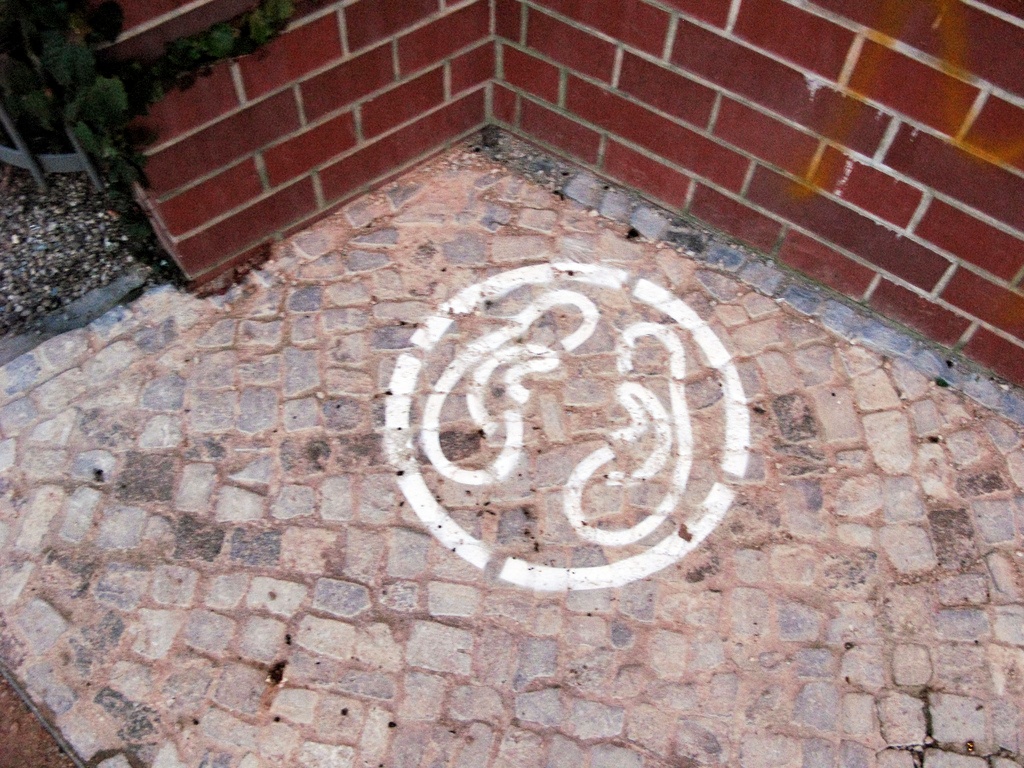
Oto-date is probably the most telling example of sound-walks without any electronic or technology. These itineraries meander fleetingly and erratically through various urban centers such as Berlin, Paris, Turin and now Brussels. Pausing every now and again, the walk marks out sites interesting for their unusual acoustic or visual properties. Oto-date is a Japanese word: the ideograms which compose it – “oto” and “date” – respectively signify “listen” and “point”, hence “listening point”. Tracing upon asphalt, stone or any solid support a circular sign inscribed with two specular figures representing a pair of ears and two human footprints, Akio Suzuki marks out the site of an experience that promises to be literally “exceptional”.
[lang_nl]Oto-date vormt het meeste sprekende voorbeeld van een geluidswandeling zonder enige vorm van elektronica of technologie. Hiervoor zoekt Akio Suzuki in steden naar locaties met een uitzonderlijk auditief of visueel karakter. Een combinatie van voeten en oren op de grond toont het publiek waar halt te houden voor een uitzonderlijke klankervaring.[/lang_nl]
[lang_fr]Oto-date constitue le plus bel exemple d’une balade sonore sans électronique ni technologie. Akio Suzuki cherche des endroits dans la ville avec un caractère auditif ou visuel exceptionnel. Une combinaison de pieds et d’oreilles sur le sol indique au public où s’arrêter pour une expérience auditive extraordinaire.[/lang_fr]

appearance at Tuned City
Brussels / Situational Listening – 29. June 2013

[EVENT_REGIS_CATEGORY event_category_id=“007″]

The art of sound walks

lecture by Joost Fonteyne (BE)

Joost Fonteyne talks about the art of sound walks. Sound Walks have a long tradition. Back in 1965, Max Neuhaus would take his audience outside in ‚LISTEN‘, to listen to the city. Pioneer Hildegard Westerkamp described it as any excursion whose main purpose is listening to the environment. Does it still pay to organise sound walks if the practice of deep listening is as good as moribund? Are we, in fact, aware of the sounds around us? Or do the makers of sound walks invite us precisely to experience the often urban environment in a different way?

[lang_nl]Joost Fonteyne spreekt over de kunst van het geluidswandelen. Loont het nog de moeite om geluidswandelingen te organiseren als de praktijk van ‚deep listening‘ op sterven na dood is? Zijn we ons nog bewust van het geluid van onze omgeving? Of worden we net uitgenodigd om de veelal stedelijke omgeving op een andere manier te beleven?
[/lang_nl]

[lang_fr]Joost Fonteyne parle de l’art de la promenade sonore. Vaut-il encore la peine de les organiser alors que la pratique de ‚deep listening‘ en est à ses derniers sursauts? Est-ce que nous sommes encore conscients des bruits de notre environnement? Ou bien les créateurs nous invitent-ils justement à vivre l’entourage surtout citadin d’une autre manière? [/lang_fr]

appearance at Tuned City
Brussels / Situational Listening – 29. June 2013